If you have ever tried to translate in Marathi to English using a basic online tool, you know the result can sometimes read like a puzzle written by a confused robot. The grammar flips, the tone goes stiff, and the actual meaning gets lost somewhere between the verb endings. This article is a practical guide to fixing that problem. Whether you are translating a WhatsApp message from a relative in Pune, a legal notice, or a line from a Marathi movie, you will learn how to get a result that actually sounds like English.
Quick Answer: For quick, everyday translation, Google Translate and Microsoft Translator are the fastest. For accuracy with complex grammar or professional documents, use a human translator or a specialized dictionary like the Shabdkosh app.
Why Direct Translation Often Fails
Marathi and English belong to different language families. Marathi is an Indo-Aryan language with a Subject-Object-Verb (SOV) structure. English uses Subject-Verb-Object (SVO). This means a sentence like “मी जेवण केले” (I meal did) must be rearranged to “I ate the meal” rather than translated word for word.
The biggest issue is the vibhakti pratyay (case endings). Marathi relies heavily on suffixes attached to nouns to show relationships. English uses prepositions like “to”, “from”, and “of”. A machine that does not recognize these suffixes will produce garbled output.
Another trap is the polite register. Marathi has three levels of formality: tu (casual), tumhi (formal), and aapan (very formal). When you translate in Marathi to English, you lose this nuance. “तुम्ही कसे आहात?” and “तू कसा आहेस?” both become “How are you?” The English reader loses the social context.
Pro Tip: If the original Marathi text uses “तुम्ही” or “आपण”, the English translation should lean toward polite, professional language. If it uses “तू”, keep the English casual.
The solution is not to translate words, but to translate meaning. Identify the subject, the object, and the verb root first. Then rebuild the sentence in English order.
Best Tools for Marathi to English Translation
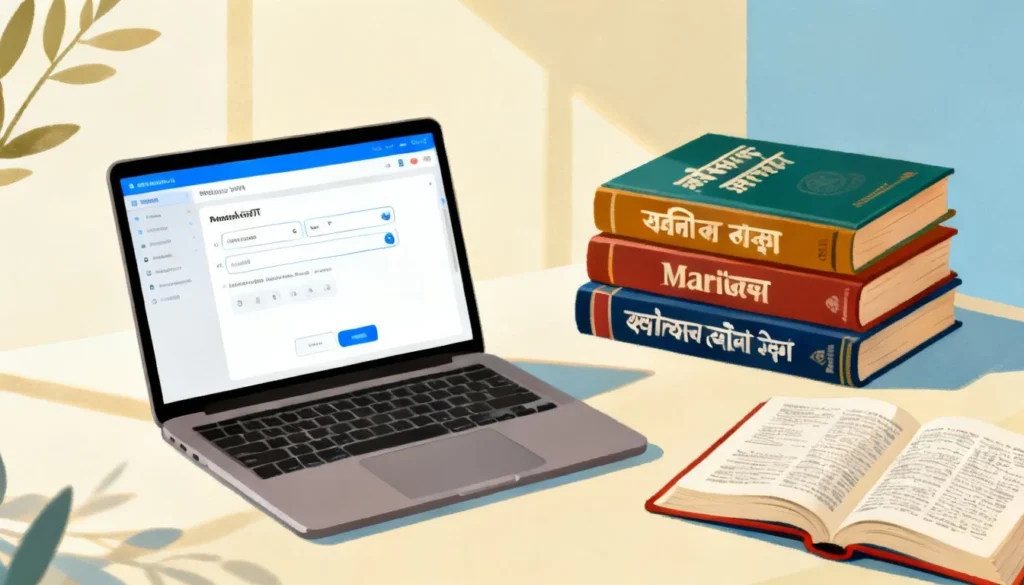
Not all tools handle Marathi equally well. Here is a breakdown of the most reliable options based on different needs.
| Tool | Best For | Accuracy | Offline Use |
|---|---|---|---|
| Google Translate | Quick messages, web browsing | Medium-High | Yes (with download) |
| Microsoft Translator | Conversations, live speech | Medium-High | Yes |
| Shabdkosh Dictionary | Word meanings, usage examples | High (for single words) | Yes |
| iTranslate | Travel phrases, short texts | Medium | Yes |
| Human Translator | Legal, medical, business documents | Highest | No |
Google Translate has improved significantly for Marathi since it moved to neural machine translation. It now handles common idioms and sentence restructuring much better than it did five years ago. However, it still struggles with proverbs and sarcasm.
Microsoft Translator is notably good for spoken Marathi. Its live conversation mode allows two people to speak naturally, and it translates in real time. This is useful for family conversations or business calls.
For single words, Shabdkosh remains the gold standard. It shows multiple meanings, grammatical categories, and example sentences. This is the tool to use when you need to understand why a word translates a certain way, not just what it means.
Pro Tip: Never rely on a machine translation for a document you will sign or submit to a government office. The cost of a human translator is far lower than the cost of a mistranslated legal clause.
Step by Step: How to Translate a Sentence Correctly
Here is a repeatable process for getting an accurate result every time you translate in Marathi to English.
Step 1: Identify the verb root.
Look at the end of the Marathi sentence. The verb usually comes last. Find the root. For example, in “तो शाळेत जातो”, the verb is “जातो” (goes). The root is “जा” (go).
Step 2: Identify the subject.
Who is doing the action? In the example above, “तो” means “he”.
Step 3: Identify the object and location.
“शाळेत” means “to school”. The “त” suffix indicates location.
Step 4: Rebuild in English order.
Subject + Verb + Object/Location. “He goes to school.”
Step 5: Check the tense and aspect.
Marathi verbs change form based on tense, gender, and number. “जातो” is present tense, masculine, singular. Make sure your English verb matches.
Step 6: Read the English sentence aloud.
Does it sound like something a native English speaker would actually say? If it sounds stiff or unnatural, you are probably translating too literally.
Here is a more complex example:
Marathi: “मला मराठीतून इंग्रजीत भाषांतर करायला शिकायचे आहे.”
Literal word-for-word: “To me Marathi from English in translation to do to learn is.”
Correct translation: “I want to learn how to translate from Marathi to English.”
The difference is massive. The literal version is unreadable. The correct version rearranges the entire sentence structure and uses “how to” to express the desire.
Pro Tip: When a Marathi sentence uses “मला” (to me) at the beginning, it often expresses a desire, need, or feeling. The English equivalent usually starts with “I want”, “I need”, or “I feel”.
Common Mistakes When Translating Marathi to English
Understanding what goes wrong is half the battle. Here are the most frequent errors I see in machine and beginner translations.
1. Direct word order transfer.
As discussed, Marathi puts the verb last. English does not. Translating in the original order produces Yoda-like English.
2. Ignoring the “ne” (ने) suffix.
In past tense, Marathi uses “ने” to mark the agent. “रामाने रावणाला मारले” means “Ram killed Ravan”. A literal translation might say “Ram by Ravan to killed”. The “ने” tells you Ram is the doer, not the receiver.
3. Confusing gender agreement.
Marathi adjectives and verbs change based on the gender of the noun. English does not do this. When translating, you must strip out the gender markers. “ती सुंदर आहे” and “तो सुंदर आहे” both become “She is beautiful” and “He is handsome” respectively, but the adjective “सुंदर” changes form in Marathi. English does not need that change.
4. Over-literal idiom translation.
Marathi idioms rarely translate directly. “अंगावर काटा येणे” literally means “a thorn comes on the body”. The actual meaning is “to get goosebumps”. A good translator recognizes the idiom and finds the English equivalent.
5. Dropping the politeness level.
As mentioned earlier, the formal “तुम्ही” and the casual “तू” both become “you” in English. If the original text is a formal letter, your English translation should use formal language like “Dear Sir” and “I request you to” rather than “Hey” and “Can you”.
Pro Tip: If you are translating a Marathi business email, look for words like “कृपया” (please), “विनंती” (request), and “धन्यवाद” (thank you). These signal a formal register. Your English should match that formality.
Using Context to Choose the Right Word
One Marathi word can have multiple English meanings depending on context. This is where dictionaries fall short and human judgment matters.
Take the word “काम” (kaam). It can mean:
- Work (as in a job): “मला कामावर जायचे आहे” = “I have to go to work”
- Task or errand: “माझे एक काम आहे” = “I have a task to do”
- Function or purpose: “या मशीनचे काम काय?” = “What is the function of this machine?”
- Deed or action: “त्याचे काम चांगले आहे” = “His deeds are good”
A machine translator will often default to “work” for every instance. That is not wrong, but it is not precise. The word “काम” in the context of “माझे एक काम आहे” is better translated as “errand” or “favor” depending on the situation.
Similarly, “ठीक” (theek) can mean:
- Okay or fine: “मी ठीक आहे” = “I am fine”
- Correct: “तुझे उत्तर ठीक आहे” = “Your answer is correct”
- Fixed or repaired: “गाडी ठीक झाली” = “The car is fixed”
Pro Tip: Before translating a sentence, read the entire paragraph first. The surrounding sentences will tell you which meaning of a word fits best. Never translate sentence by sentence in isolation.
The key to accurate translation is not knowing more words. It is knowing which meaning fits the situation. That is why context always beats vocabulary size.
Key Takeaways
- Marathi and English have opposite sentence structures, so you must rearrange words, not just replace them.
- Use Google Translate or Microsoft Translator for quick, casual text. Use a human translator for legal, medical, or business documents.
- The “ने” suffix in Marathi past tense marks the doer of the action. Ignoring it reverses the meaning.
- Context determines word choice. One Marathi word like “काम” can mean work, task, errand, or function.
- Always read your English translation aloud. If it sounds unnatural, you are translating too literally.
Frequently Asked Questions
Q: What is the best free tool to translate in Marathi to English?
A: Google Translate is the best free tool for most users. It handles sentence restructuring reasonably well and offers offline translation if you download the Marathi language pack. Microsoft Translator is a close second, especially for spoken conversations.
Q: Can I translate a Marathi PDF document to English?
A: Yes. You can upload the PDF to Google Translate by clicking the “Documents” button. However, the formatting will not be preserved. For legal or official PDFs, it is better to use a professional translation service that can maintain the layout.
Q: Why does Google Translate sometimes give wrong translations for Marathi?
A: Google Translate struggles with Marathi idioms, sarcasm, and sentences where the subject is implied rather than stated. Marathi often drops pronouns because the verb ending tells you who is doing the action. English requires the pronoun, and the machine does not always reconstruct it correctly.
Q: How do I translate Marathi handwriting to English?
A: Use the Google Lens app. Point your camera at the handwritten Marathi text, select the text, and choose “Translate” to English. The accuracy depends on the clarity of the handwriting.
Q: Is there a reliable Marathi to English dictionary app?
A: Yes. The Shabdkosh app is the most reliable for Marathi to English word meanings. It provides grammatical categories, usage examples, and synonyms. It also works offline after you download the dictionary.
Q: Can I use ChatGPT to translate Marathi to English?
A: Yes, ChatGPT and other large language models often produce more natural translations than Google Translate for complex sentences. However, they can hallucinate or add information that was not in the original text. Always verify the output against a dictionary if the text is important.
Q: What is the difference between “तुम्ही” and “तू” in English translation?
A: Both words translate to “you” in English. “तुम्ही” is formal and respectful, used for elders and strangers. “तू” is casual, used for friends and younger people. The English translation loses this distinction, so you must compensate by adjusting the overall tone of the sentence.
Q: How do I translate Marathi voice messages to English text?
A: Use the Google Translate app. Tap the microphone icon, speak in Marathi, and the app will transcribe and translate to English in real time. For pre-recorded voice notes, play the note on speaker while the app listens.
References & Further Reading
- Google Translate Help: Translate documents and websites
- Microsoft Translator: Language support and features
- Shabdkosh: English Marathi Dictionary
- Ethnologue: Marathi Language Profile
—
About This Article: This guide is written by a bilingual content strategist who works with Marathi and English texts on a daily basis. The methods described here reflect common translation practices used by professional linguists and are based on the grammatical structures documented in standard Marathi language references.