Learning how to translate to Marathi opens the door to communicating with more than 83 million native speakers, primarily in the Indian state of Maharashtra. Whether you are sending a message to family, localizing a website for the Indian market, or working on official documents, getting the translation right matters. A literal, word-for-word swap almost always fails because Marathi, an Indo-Aryan language, has its own sentence structure, honorifics, and cultural nuances. This guide walks you through the best methods, tools, and strategies to ensure your text sounds natural to a native speaker, not like a robot read a dictionary.
Quick Answer: The most accurate way to translate to Marathi is to use a hybrid approach. Start with a machine translation engine like Google Translate or DeepL for speed, then have a native Marathi speaker review the output for grammar, tone, and cultural context. Avoid relying solely on free tools for legal, medical, or marketing content.
Understanding Why Marathi Translation Is Tricky
Marathi is not simply Hindi with different words. It has a distinct grammatical framework that heavily relies on cases, verb conjugations, and gendered nouns. If you are coming from English, the biggest hurdle is usually the Subject-Object-Verb (SOV) sentence structure.
In English, you say “I eat an apple.” In Marathi, the natural order translates roughly to “I an apple eat.” This structural shift means that direct, linear translation often produces garbled results.
The Gender and Formality Challenge
Unlike English, Marathi nouns are gendered. A chair and a table are not just objects; they are assigned grammatical genders that affect the verbs and adjectives around them. Furthermore, Marathi has three levels of formality:
- तू (Tu): Informal, used for close friends, children, or pets.
- तुम्ही (Tumhi): Formal or respectful, used for elders, strangers, and professional settings.
- आपण (Aapan): Inclusive “we” or a highly respectful form, often used to refer to a person of high status.
If you translate a business email using the informal “tu,” you risk offending the recipient. A machine might not always catch the social context required to choose the right pronoun. The key is to understand that translation is a cultural act, not just a linguistic one.
Pro Tip: When in doubt, always default to the formal “tumhi” form. It is better to be overly polite than accidentally rude.
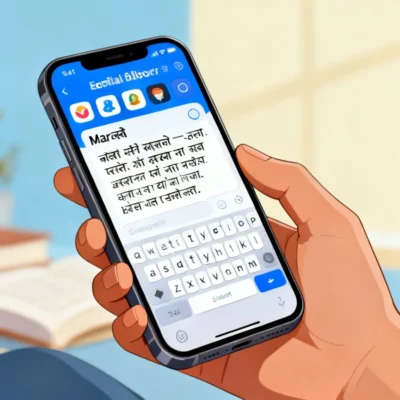

Comparing the Best Tools to Translate to Marathi
When you need to translate to Marathi quickly, you have several options. They range from free, instant solutions to paid, human-powered services. The right choice depends entirely on the stakes of your project.
Here is a breakdown of the most common methods:
| Tool / Method | Best For | Accuracy Level | Cost | Speed |
|---|---|---|---|---|
| Google Translate | Casual chats, getting the gist of a text | Medium (Grammar often stiff) | Free | Instant |
| DeepL | European language nuance (less robust for Marathi) | Medium-Low | Freemium | Instant |
| Microsoft Translator | Business integration (Teams, Office) | Medium | Free/Paid | Instant |
| Professional Agency | Legal, medical, marketing copy | High (Human reviewed) | High | Days |
| Freelance Native Speaker | Websites, apps, personal letters | High | Medium | Hours/Days |
Evaluating Free Machine Translators
Google Translate supports Marathi and has improved dramatically with neural machine translation. It is excellent for understanding a message you received. However, if you type an English idiom like “break a leg” into the translator, you will likely get a Marathi sentence about physically breaking a bone, which is nonsensical to a native speaker.
Microsoft Translator is a solid alternative, particularly if you are working within the Microsoft ecosystem. It handles basic conversational text well but shares the same limitations regarding slang and complex syntax.
When to Hire a Human
For anything that impacts your brand reputation or legal standing, you need a human. A professional translator does not just swap words; they transcreate. This means they take the intent of your English sentence and rebuild it using the idioms and rhythms that a Marathi speaker actually uses. For example, a marketing slogan like “Taste the Feeling” cannot be translated literally; it must be adapted to evoke the same emotion in Marathi.
Pro Tip: If you are using a freelance translator, ask them to provide a back-translation. This is an English translation of their Marathi text. It helps you verify that the meaning survived the transition without you having to speak the language.
Step-by-Step: How to Translate English to Marathi Accurately
To get a result that reads naturally, follow a structured workflow. Rushing the process or skipping the review step is where most mistakes happen.
Step 1: Simplify the Source Text
Before you even open a tool, clean up your English. Remove idioms, slang, and complex compound sentences. Write short, clear sentences.
- Bad: “We need to touch base regarding the paradigm shift in our quarterly deliverables.”
- Good: “We need to discuss the changes in our quarterly goals.”
Simple English translates to simple Marathi. Complex English often translates to confusing Marathi.
Step 2: Run the Machine Translation
Paste your simplified text into your chosen tool. Look at the output. Do not copy it yet. Identify the nouns and verbs. Check if the tool seems to have preserved the tense. This is your draft.
Step 3: The Native Review (The Most Critical Step)
This is non-negotiable for professional work. You must have a native speaker read the draft. They will catch things you cannot see:
- Word Choice: Marathi has multiple words for “you,” “come,” and “go” depending on respect and direction.
- Collocation: Some words simply do not go together in Marathi, even if they are technically correct.
- Tone: Is the text too stiff? Too casual?
If you don’t have a native speaker on hand, communities on Reddit (like r/marathi) or language exchange apps can sometimes offer feedback for short phrases.
Step 4: Formatting and Script
Ensure the text is rendering in Devanagari script correctly. Check for broken conjuncts (joined letters) or misplaced vowel signs. A common issue with digital text is the rendering of the “z” sound or the distinction between hard and soft consonants. Verify that the font you are using supports Marathi properly if you are pasting into design software.
By following these steps, you move from a mechanical swap to a genuine communication of ideas.
Common Mistakes to Avoid When You Translate to Marathi
Most errors in Marathi translation come from treating the language as a code to be cracked rather than a living system of communication. Here are the pitfalls I see most often:
- Ignoring Gender Agreement: If you say “The door is open,” the word for “open” changes depending on whether the door is masculine or feminine in Marathi. A machine often guesses wrong.
- Mixing Scripts: Sometimes people try to write Marathi using the Latin alphabet (Romanized Marathi). While common in texting, it is unprofessional for formal documents. Always use Devanagari script for official work.
- Literal Translation of Phrasal Verbs: English is full of verbs like “put up with,” “look after,” or “run out of.” These cannot be translated word-by-word. You must find the single Marathi verb that matches the meaning.
- Ignoring Regional Dialects: Standard Marathi is based on the Pune dialect. However, speakers in Vidarbha, Konkan, or Marathwada have distinct variations. If you are targeting a specific region, your translation should reflect that local flavor.
The Context of Code-Switching
Modern Marathi speakers, especially in urban areas like Mumbai and Pune, often mix English words into their Marathi. This is called code-switching. A translation that is too pure can sound archaic or overly formal.
For example, a speaker might say “मी ऑफिसला जातोय” (Mi officela jatoy), using the English word “office” with Marathi grammar. If you are translating a casual app interface, using the Marathi word for “office” (कार्यालय – karyalay) might feel unnatural to a young user. Understanding your audience’s demographic is crucial for hitting the right tone.
Key Takeaways
- Accuracy requires context: Machine translation is a starting point, not a finish line, when you translate to Marathi.
- Respect the grammar: Marathi uses SOV sentence structure and gendered nouns, which differ significantly from English.
- Formality matters: Always verify the level of respect (tu vs. tumhi) being used in your translation.
- Simplify first: Clear, direct English source text yields the most accurate Marathi output.
- Human review is essential: For any public-facing or legal content, a native speaker must validate the translation.
Frequently Asked Questions About Translating to Marathi
Q: Is Google Translate accurate for English to Marathi?
A: Google Translate is generally accurate for simple, conversational sentences and for understanding the gist of a text. However, it often struggles with complex grammar, idioms, and cultural context, making it unreliable for professional or legal documents without human review.
Q: How do I translate a PDF document to Marathi?
A: You can upload the PDF directly to Google Translate in a web browser, and it will attempt to preserve the formatting while translating the text. For high-quality results, it is better to extract the text, translate it manually or with a tool, and then reformat the document.
Q: What is the difference between Marathi and Hindi translation?
A: While both use the Devanagari script, they are distinct languages. Marathi has different verb conjugations, vocabulary, and a stronger influence from Dravidian languages in its grammar. A Hindi speaker cannot automatically read or understand Marathi perfectly.
Q: Can I write Marathi in English letters?
A: Yes, this is called Romanized Marathi or “Minglish.” It is very common in text messages and social media. However, for formal writing, education, and official documents, the Devanagari script is required and expected.
Q: How much does it cost to translate a document to Marathi?
A: For professional human translation, costs typically range from $0.10 to $0.25 per word, depending on the complexity and the agency. Freelancers may charge lower rates. Machine translation is free but carries a higher risk of errors.
Q: What is the best app to learn Marathi for translation purposes?
A: Apps like Duolingo, Memrise, and the “Learn Marathi Quickly” app are popular for building vocabulary. However, for translation, a dedicated dictionary app like the one from Shabdkosh or a Marathi grammar reference book is more useful.
Q: Why does my Marathi translation look different from what I typed?
A: This is usually a font rendering issue. Marathi uses complex ligatures where letters combine. Ensure your system has a Unicode-compliant font like Nirmala UI or Noto Sans Marathi installed to display the script correctly.
Q: Is Marathi spoken outside of India?
A: Yes, there are significant Marathi-speaking diaspora communities in the United States, United Kingdom, United Arab Emirates, and Israel. The language is also one of the 22 scheduled languages of India.
References & Further Reading
- Google Translate Help: Translate documents & websites
- Government of India: Department of Official Language
- Ethnologue: Marathi Language Profile
—
About This Article: This guide was compiled based on linguistic principles of the Marathi language and practical experience with localization workflows. It aims to provide a realistic overview of the challenges and solutions involved in English-to-Marathi translation, prioritizing accuracy and cultural respect over speed.