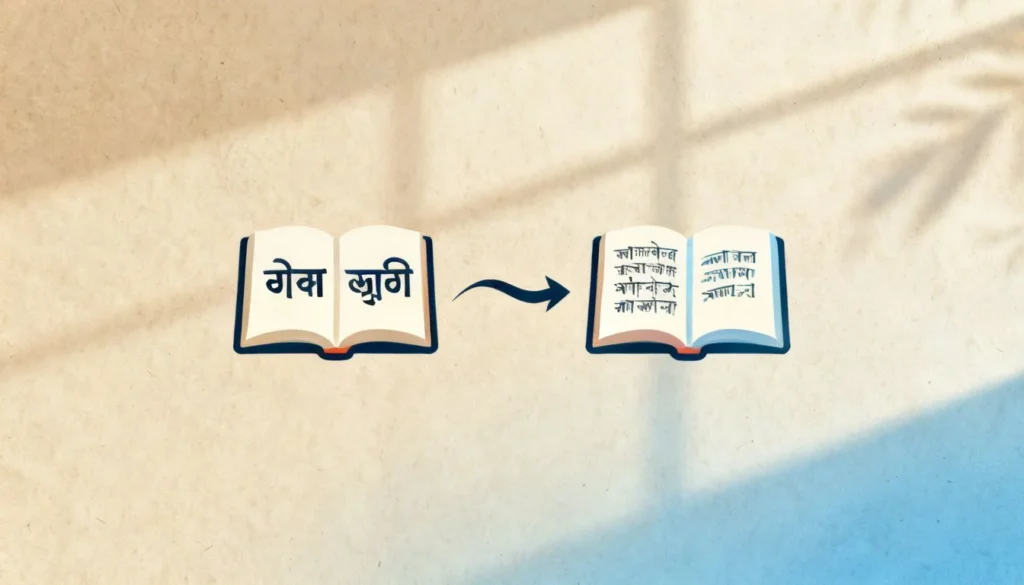
Translation Marathi to English is something millions of people need every single day. Whether you are filling out a government form, helping your child with homework, or trying to explain a recipe to a friend abroad, the gap between these two languages can feel wide. Marathi has a rich grammatical structure that does not map neatly onto English. Word order changes. Verb forms shift. What sounds natural in Pune can sound broken in London if translated word-for-word.
This article walks you through the entire process. You will learn how to choose the right method for your situation, understand the grammar patterns that cause most errors, and avoid the mistakes that make translations sound robotic or wrong.
Quick Answer: For everyday phrases and quick understanding, Google Translate or Microsoft Translator work fine. For official documents, academic work, or anything where accuracy matters legally or professionally, use a combination of machine translation plus human review, or hire a certified translator who knows both Marathi and English natively.
Why Marathi to English Translation Is Harder Than It Looks
Marathi belongs to the Indo-Aryan language family. English is Germanic. That alone creates structural friction. But the real difficulty comes from three specific areas: sentence structure, verb agreement, and honorifics.
Marathi follows a Subject-Object-Verb (SOV) pattern. English uses Subject-Verb-Object (SVO). So the Marathi sentence “मी पुस्तक वाचतो” (mi pustak vachto) literally translates as “I book read.” A word-by-word approach produces “I book read,” which is wrong. The correct translation is “I read a book.”
Verb agreement in Marathi depends on gender, number, and person simultaneously. English verbs barely change by person. “I go,” “you go,” “we go.” Marathi verbs change for all of these: “मी जातो” (mi jato, masculine), “मी जाते” (mi jate, feminine). An English speaker learning this finds it confusing. A translator going the other direction has the opposite problem: English does not mark gender on verbs, so the translator must decide whether to add “he” or “she” based on context that Marathi already encodes.
Honorifics add another layer. Marathi uses आपण (aapan) for formal “you” and तू (tu) for informal. English has only “you.” A translator must infer the relationship from context and sometimes add “sir,” “madam,” or adjust tone to preserve the respect level.
Where People Usually Go Wrong
The most common errors in translation Marathi to English fall into predictable buckets:
- Literal word order transfer , keeping Marathi’s SOV order instead of switching to English’s SVO
- Missing articles , Marathi has no equivalent of “a,” “an,” or “the,” so learners and machines often drop them
- Tense confusion , Marathi expresses continuous and habitual actions differently than English does
- Postposition errors , Marathi uses postpositions (after nouns) while English uses prepositions (before nouns)
Pro Tip: When checking a Marathi to English translation, read the English output aloud. If it sounds like Yoda from Star Wars (“The book I read”), the word order probably needs fixing.
Understanding these structural differences makes you a better judge of translation quality, whether you do it yourself or use a tool.
Choosing the Right Translation Method for Your Needs
Not all translation tasks are equal. Translating a WhatsApp message to your cousin in London is different from translating a birth certificate for a visa application. Here is a breakdown of the main approaches and when each makes sense.
Machine Translation Tools
Google Translate supports Marathi and has improved significantly over the years. Microsoft Translator and Bing also support Marathi. These tools work best for:
- Short conversational phrases
- Getting the gist of a news article or social media post
- Quick communication when precision is not critical
They fail when the text contains idioms, cultural references, legal terminology, or complex sentence structures. A Marathi proverb like “अडला हरी गाढवाचे पाय धरी” (adla hari gadhvache pay dhari) translates literally as “When in trouble, Hari holds a donkey’s legs.” The actual meaning is closer to “Desperate times call for desperate measures.” Machine tools often miss this entirely.
Human Translation
For official documents, academic transcripts, legal contracts, and medical records, human translation is non-negotiable. A certified translator understands nuance, preserves tone, and can add translator’s notes where cultural context matters.
Hybrid Approach
This is what I recommend for most people. Run the text through a machine translator first. Then review the output yourself or have someone proficient check it. Fix the word order, add missing articles, and adjust awkward phrasing. This gives you speed without sacrificing too much accuracy.
| Method | Best For | Accuracy | Cost | Speed |
|---|---|---|---|---|
| Google Translate | Casual chat, gist understanding | Medium | Free | Instant |
| Microsoft Translator | Similar to Google, good for phrases | Medium | Free | Instant |
| Hybrid (Machine + Human review) | Business emails, blog posts, general documents | High | Low to medium | Fast |
| Professional human translator | Legal, medical, academic, official documents | Very high | High | 1 to 5 days |
| Certified translation service | Visa applications, court documents, immigration | Highest (certified) | Highest | 2 to 7 days |
The method you choose should match the stakes. A mistranslated birthday wish is funny. A mistranslated property deed is a legal problem.
Pro Tip: If you are using Google Translate for Marathi, type in complete sentences rather than fragments. The tool uses context to resolve ambiguity, and fragments give it less to work with.
Common Grammar Patterns That Trip Up Marathi to English Translation
Once you understand the common patterns, you can spot errors quickly. Here are the ones I see most often.
The Article Problem
Marathi does not use articles. English requires them in most contexts. When translating “तो डॉक्टर आहे” (to doctor aahe), the correct English is “He is a doctor,” not “He is doctor.” Machine translators have gotten better at this, but they still miss it when the noun is modified by a relative clause or when the sentence is long.
The Continuous Tense Overuse
Marathi speakers often overuse the present continuous tense in English because Marathi uses the continuous form more frequently. “मी येतो आहे” (mi yeto aahe) literally means “I am coming.” But in Marathi, this is a common way to say “I am on my way” or even “I will come.” In English, “I am coming” implies you are physically moving right now. The correct translation depends on context: “I am coming now,” “I will come,” or “I am on my way.”
Postpositions Becoming Prepositions
Marathi postpositions attach to the end of nouns. “घरात” (gharat) means “in the house.” “घरा” (ghara) plus “त” (t) gives you the location. English puts “in” before “the house.” A translator must flip this order every single time. When sentences have multiple postpositions or nested phrases, this flipping becomes error-prone.
Gender and Pronoun Reference
Marathi marks gender on verbs and adjectives. When translating to English, the translator must ensure pronoun references are clear. “ती शाळेत जाते” (ti shalet jate) means “She goes to school.” The verb “जाते” (jate) already tells you the subject is feminine. In English, you need the pronoun “she” to carry that information. If the previous sentence was about a male teacher and a female student, the translator must choose the right pronoun based on the verb form.
A Practical Example
Here is a Marathi sentence and a breakdown of how to translate it properly:
Marathi: “माझ्या आईने मला सांगितले की उद्या पाऊस पडणार आहे.”
Word-by-word (wrong): “My mother by me told that tomorrow rain falling is.”
Correct translation: “My mother told me that it will rain tomorrow.”
Notice the changes: postposition “ने” (ne) becomes the subject marker, word order flips from SOV to SVO, “पाऊस पडणार आहे” (rain falling is) becomes “it will rain,” and the entire sentence flows naturally in English.
Understanding these patterns helps you evaluate any translation you get, whether from a tool or a person.
Tools and Resources for Better Marathi to English Translation
The right tools make a significant difference. Here is what actually works, based on practical use.
Google Translate
Google Translate supports Marathi text, voice, and camera input. The camera feature is useful for translating signs, menus, and printed documents on the go. The quality for Marathi has improved substantially since Google switched to neural machine translation. For conversational text, it is reliable enough for understanding. For output you will publish or submit officially, it needs review.
Microsoft Translator
Microsoft Translator also supports Marathi and integrates with Office apps. If you work in Word or Outlook, this is convenient. The quality is comparable to Google Translate for Marathi, though Google tends to handle colloquial phrases slightly better.
Marathi-English Dictionaries
For single words and short phrases, dedicated dictionaries offer more nuance than machine translators. The Molesworth Marathi-English Dictionary is a classic reference, though dated. The Date-Karve dictionary is another traditional option. For modern usage, online dictionaries like Shabdkosh and Maxgyan provide Marathi-English entries with examples.
Typing Tools
If you need to type Marathi before translating, Google Input Tools lets you type Marathi using an English keyboard. It transliterates as you type. This is useful when you have handwritten Marathi text that you need to digitize first.
When to Use What
Here is a simple decision flow:
- Casual conversation: Google Translate or Microsoft Translator, no review needed
- Understanding content: Machine translation, skim the output
- Writing in English from Marathi thoughts: Machine translation plus your own editing
- Official documents: Human translator, machine tools only for reference
- Learning English: Use dictionaries and grammar references alongside translation tools
Pro Tip: Keep a personal glossary of phrases you translate often. Over time, you will build a reference that is more accurate than any generic tool because it reflects your specific context, whether that is medical terminology, legal language, or family communication.
The tools are getting better every year, but none of them understand context the way a human does. Use them as assistants, not replacements for judgment.
Step-by-Step Process for Accurate Translation Marathi to English
Here is a repeatable workflow I use when translating Marathi to English for anything that matters.
Step 1: Read the Entire Source Text First
Do not start translating sentence by sentence. Read the whole Marathi passage once. Understand the main point, the tone, and the relationship between the speakers or writer and audience. This context shapes every word choice you make afterward.
Step 2: Identify the Text Type
Is this a formal letter, a casual conversation, a technical document, or a literary passage? The register of the English output must match. A formal Marathi letter using “आपण” (aapan) should become formal English with “you” but a respectful tone, possibly adding “sir” or “madam” where natural.
Step 3: Break Into Logical Chunks
Divide the text into sentences or short paragraphs. Translate each chunk, but keep the previous chunk in mind. This prevents the disconnected feeling that machine translations often have.
Step 4: Translate the Meaning, Not the Words
For each chunk, ask yourself: what is this sentence actually saying? Then write that meaning in natural English. Do not try to preserve Marathi word order or grammatical structures. English has its own rhythm and logic.
Step 5: Add the Missing Pieces
English requires articles, pronouns, and sometimes auxiliary verbs that Marathi omits. Go through your draft and add “a,” “an,” “the,” and clarifying pronouns where needed. Check that every English sentence has a clear subject and verb.
Step 6: Read the English Output Alone
Put the Marathi source away. Read only the English translation. Does it sound like something a native English speaker would write or say? If it sounds awkward, fix it. The goal is natural English, not a mirror image of Marathi.
Step 7: Check Against the Source
Go back to the Marathi and verify that you have not added or removed meaning. This catches both errors of omission (dropping a detail) and errors of addition (inserting something that was not there).
Step 8: Get a Second Opinion
If the translation matters, have someone else read it. A fresh pair of eyes catches awkward phrasing and errors you have become blind to after working on the text.
Pro Tip: Wait at least 30 minutes between finishing your draft and doing the final check. Your brain needs distance to spot errors. This works for writing in general, not just translation.
This process takes longer than hitting “translate” on Google, but the results are dramatically better for anything that will be read by another person.
Key Takeaways
- Translation Marathi to English requires understanding structural differences: SOV vs SVO word order, postpositions vs prepositions, and gender-marked verbs
- Machine translation tools work for casual use but struggle with idioms, cultural references, and formal documents
- The most common errors are literal word order, missing articles, tense confusion, and pronoun reference mistakes
- A hybrid approach (machine translation plus human review) offers the best balance of speed and accuracy for most non-official tasks
- Official documents, legal matters, and academic work require certified human translators who understand both languages natively
Frequently Asked Questions
Q: Is Google Translate accurate for Marathi to English?
A: Google Translate is reasonably accurate for short, simple sentences and everyday phrases. For complex sentences, idioms, or formal text, it can produce awkward or incorrect results. It works best as a starting point that you review and refine, not as a final translation for anything important.
Q: How can I translate Marathi to English for free?
A: Google Translate, Microsoft Translator, and Bing Translator all offer free Marathi to English translation. You can also use free online dictionaries like Shabdkosh for individual words. For better accuracy on longer texts, combine a free machine translation with your own review and editing.
Q: What is the best app for Marathi to English translation?
A: Google Translate is the most widely used app for Marathi to English because it supports text, voice, and camera input. Microsoft Translator is a strong alternative, especially if you work within Microsoft Office apps. Both are free and available on Android and iOS.
Q: Can I translate a Marathi PDF to English?
A: Yes. You can use Google Translate’s document upload feature, which accepts PDF files. The output preserves basic formatting but may have layout issues. For official documents, you should have the translated output reviewed by a human translator, especially if the PDF contains legal or technical content.
Q: Why does my Marathi to English translation sound unnatural?
A: Unnatural translations usually come from preserving Marathi word order (SOV) instead of switching to English order (SVO), missing articles, or translating idioms literally. Reading the English output aloud and rewriting it to sound like natural English fixes most of these issues.
Q: How do I translate Marathi handwriting to English?
A: Google Translate’s camera feature can capture printed Marathi text and translate it. For handwritten Marathi, accuracy depends on how clear the handwriting is. If the camera tool struggles, you can type the Marathi text using Google Input Tools and then translate the typed text.
Q: What is the difference between Marathi to English and English to Marathi translation?
A: The challenges are different in each direction. Marathi to English requires adding articles and adjusting word order. English to Marathi requires adding gender markers, honorifics, and choosing the correct verb form based on the subject’s gender and number. Both directions require understanding context.
Q: How much does professional Marathi to English translation cost?
A: Professional translation rates vary by region and document type. In India, Marathi to English translation typically ranges from ₹1 to ₹3 per word for general documents. Certified translations for official use cost more. Complex technical or legal documents command higher rates. Always ask for a quote before starting.
Q: Can I become a Marathi to English translator?
A: Yes. You need strong proficiency in both languages, ideally native-level Marathi and advanced English. Formal training in translation, linguistics, or a specialized field (legal, medical, technical) helps. Certification from organizations like the American Translators Association or Indian translation bodies adds credibility.
Q: What are common Marathi phrases that are hard to translate to English?
A: Idioms and culturally specific phrases are hardest. “अडला हरी गाढवाचे पाय धरी” means “Desperate times call for desperate measures,” not the literal “Hari holds a donkey’s legs.” Phrases involving respect, family relationships, and food often lack direct English equivalents and require explanatory translation.
References & Further Reading
- Google Translate Support: Translate documents and websites , Official guidance on using Google Translate for document and web translation
- Ethnologue: Marathi language profile , Linguistic data on Marathi speakers, dialects, and language classification
- Central Institute of Indian Languages: Marathi resources , Government institute offering language learning and translation resources for Indian languages including Marathi
- American Translators Association: Guide to translation and interpretation , Information on hiring translators, certification standards, and what to expect from professional translation services
—
About This Article: This guide was written based on practical experience with Marathi-English translation across casual, academic, and official contexts. The grammar patterns described reflect standard Marathi as spoken in Maharashtra. Translation quality varies by dialect, region, and context, so always review important translations with a qualified human translator.