When you need to translate English to Marathi paragraph by paragraph, the real challenge isn’t finding a tool. It’s keeping the meaning intact while navigating two fundamentally different language structures. English follows Subject-Verb-Object order. Marathi uses Subject-Object-Verb. Verbs change based on gender, number, and formality. A direct word-for-word swap produces gibberish. This guide walks you through the actual process that preserves both accuracy and natural flow.
Quick Answer: For accurate paragraph translation, avoid single-word tools. Use context-aware engines like Google Translate or DeepL for drafts, then manually adjust for Marathi’s SOV structure, gender agreement, and cultural phrasing. Machine translation handles about 70% of the work. The remaining 30% requires human judgment.
Why Paragraph Translation Is Different From Word Translation
Context changes everything. A single Marathi word can shift meaning based on the sentence around it. The English word “run” might mean धावणे (dhaavne, to sprint), चालवणे (chaalvne, to operate a machine), or even वाहणे (vaahne, for a running nose). Without the surrounding paragraph, you pick the wrong one.
Paragraph-level translation also forces you to handle Marathi’s gender system. Every noun carries gender. Verbs and adjectives must agree. When you translate English to Marathi paragraph by paragraph, you need to track the subject’s gender across multiple sentences. A paragraph about a female teacher uses different verb endings than one about a male teacher. Miss this, and the entire paragraph sounds broken to a native speaker.
Marathi is spoken by over 83 million people, primarily in Maharashtra. It’s the third most spoken language in India. The Devanagari script adds another layer. You’re not just translating words. You’re converting from a Latin alphabet to a script with 13 vowels and 36 consonants, each with specific conjunct forms.
Pro Tip: Before translating, identify the paragraph’s main subject and its gender. This single step prevents cascading errors across every sentence that follows.
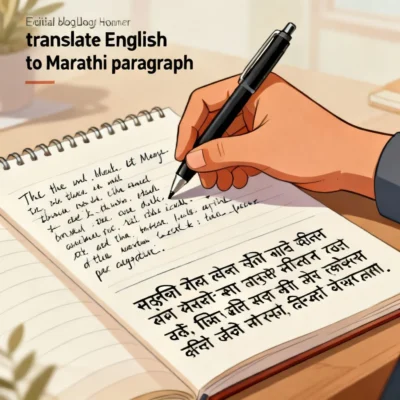
Step by Step: How to Translate English to Marathi Paragraph Without Losing Meaning
Step 1: Break the Paragraph Into Logical Chunks
Don’t dump the entire paragraph into a translator and hope for the best. Split it at natural pause points. Periods, semicolons, and long dashes in the original text mark good boundaries. Each chunk should express one complete thought.
This matters because machine translation models process text in segments. Feed them a 200-word block, and they lose track of subject-verb relationships by the end. Smaller chunks stay coherent.
Step 2: Run Through a Context-Aware Translation Engine
Google Translate handles Marathi better than it did five years ago. Its neural machine translation now accounts for broader context. DeepL doesn’t officially support Marathi yet, but Microsoft Translator does, and it performs comparably for formal Marathi.
Paste your chunks one at a time. Review each output before moving to the next. Look for obvious errors. Did the engine swap the subject and object? Marathi requires SOV order. If the English sentence was “She ate the mango,” the correct Marathi structure is “She the mango ate” (तिने आंबा खाल्ला). If the output shows तिने खाल्ला आंबा, the order is wrong.
Step 3: Verify Gender and Number Agreement
This is where most automated translations fail. Marathi has three genders: masculine, feminine, and neuter. The verb form changes accordingly.
| English Sentence | Incorrect Machine Output | Correct Marathi | Error Type |
|---|---|---|---|
| The boy went | मुलगा गेली | मुलगा गेला | Feminine verb with masculine subject |
| The girl spoke | मुलगी बोलला | मुलगी बोलली | Masculine verb with feminine subject |
| The books are here | पुस्तकं इथे आहे | पुस्तकं इथे आहेत | Singular verb with plural subject |
Over 60% of machine translation errors in Marathi involve gender or number mismatch. Check every verb against its subject. If the paragraph discusses multiple people with different genders, pay extra attention to pronoun references.
Step 4: Adjust Formality Based on Context
Marathi uses three formality levels: तू (tu, intimate), तुम्ही (tumhi, respectful singular/plural), and आपण (aapan, formal inclusive). English uses “you” for everything. The translator doesn’t know your relationship with the reader.
A business document needs तुम्ही throughout. A children’s story might use तू. A public announcement often uses आपण. Choose one and stick with it across the entire paragraph. Mixing formality levels mid-paragraph reads as sloppy or disrespectful.
Pro Tip: When translating for a general audience, default to तुम्ही. It’s safe, respectful, and never inappropriate.
Step 5: Replace Literal Phrases With Natural Marathi Expressions
English idioms don’t translate. “Break a leg” becomes a confusing literal statement about bone fractures. “It’s raining cats and dogs” makes no sense in Marathi.
For each chunk, ask yourself: would a native Marathi speaker actually say this? If the translated phrase feels stiff or foreign, find the Marathi equivalent. “Break a leg” maps to शुभेच्छा (shubhechha, best wishes). “Raining heavily” is simply जोरात पाऊस पडत आहे (jorat paaus padat aahe, heavy rain is falling).
This step separates decent translations from excellent ones. It requires either Marathi knowledge or a native speaker review.
Common Mistakes When You Translate English to Marathi Paragraph by Paragraph
Ignoring postpositions. Marathi doesn’t use prepositions like English. It uses postpositions that attach after the noun. “On the table” becomes टेबलवर (teblavar, table-on). Translators sometimes miss these or place them incorrectly.
Forgetting the oblique case. Nouns change form before postpositions. घर (ghar, house) becomes घरा (ghara) when you add “in” to make घरात (gharat, in the house). Direct translation tools often skip this inflection.
Mishandling compound verbs. Marathi frequently combines two verbs to express nuanced meaning. “To finish eating” is खाऊन टाकणे (khaaun takne, eat-finish). English expresses this with one verb plus context. Machines struggle with these constructions.
Over-relying on the default script output. Some tools output Marathi in Romanized form instead of Devanagari. If your audience expects Devanagari script, verify the output format. Romanized Marathi works for casual chat but not for formal documents.
Tools That Actually Work for English to Marathi Paragraph Translation
| Tool | Best For | Limitations | Script Support |
|---|---|---|---|
| Google Translate | General paragraphs, quick drafts | Struggles with complex literary Marathi | Full Devanagari |
| Microsoft Translator | Business and formal content | Less fluent with colloquial phrases | Full Devanagari |
| iTranslate | Mobile translation on the go | Paragraph length limits on free tier | Full Devanagari |
| Marathi OCR + Translate apps | Printed document translation | Two-step process, error-prone | Depends on OCR quality |
No tool gets it perfect on the first pass. Treat the output as a solid first draft. Budget time for human review, especially for paragraphs longer than 100 words or content intended for publication.
Pro Tip: Run your translated paragraph back through the tool as Marathi-to-English. If the re-translated English version matches your original intent, the Marathi version is likely accurate.
When to Use Professional Human Translation Instead
Machine translation fits casual needs. Social media posts, personal messages, understanding incoming Marathi text. It saves time and costs nothing.
Professional translation becomes worth the investment when accuracy carries consequences. Legal documents, medical instructions, marketing copy, and literary work all demand human expertise. A mistranslated dosage instruction or contract clause creates real liability.
Quality human translation for Marathi typically costs between $0.08 and $0.15 per word. Paragraphs with specialized terminology (legal, medical, technical) run higher. The turnaround for a 500-word paragraph is usually 24 to 48 hours from a reputable translator.
Signs you need a human translator:
- The paragraph contains legally binding language
- Brand reputation depends on natural, persuasive Marathi
- The topic involves cultural sensitivities
- Previous machine translations received negative feedback from native speakers
Key Takeaways
- English to Marathi paragraph translation requires handling SOV word order, gender agreement, and formality levels that single-word translation ignores.
- Break paragraphs into smaller chunks before translating to maintain context coherence across sentences.
- Gender and number mismatch accounts for most machine translation errors in Marathi; manually verify every verb against its subject.
- Default to तुम्ही (tumhi) for general audiences unless you have a specific reason to use intimate or ultra-formal forms.
- Always back-translate (Marathi to English) as a quick accuracy check before publishing or sending the final paragraph.
Frequently Asked Questions
Q: Can Google Translate accurately translate English to Marathi paragraph by paragraph?
A: Google Translate handles straightforward paragraphs reasonably well, achieving roughly 70 to 80% accuracy for simple, non-literary content. It struggles with idioms, complex sentence structures, and maintaining consistent gender agreement across longer paragraphs. Use it for drafts, then review manually.
Q: Why does my translated Marathi paragraph sound unnatural?
A: The most common causes are incorrect word order (English SVO vs. Marathi SOV), mismatched gender between subjects and verbs, literal translation of English idioms that don’t exist in Marathi, and inconsistent formality levels. Native speaker review catches these issues.
Q: How do I handle English idioms when translating to Marathi?
A: Never translate idioms literally. Find the Marathi equivalent expression that conveys the same meaning. “Piece of cake” might become सोपं काम (sopam kaam, easy task). If no equivalent exists, rephrase the idea in plain language before translating.
Q: What is the correct formality level for Marathi paragraph translation?
A: Use तुम्ही (tumhi) for most situations: business correspondence, general audience content, and communication with acquaintances. Use तू (tu) only for close friends, children, or intentionally casual contexts. Use आपण (aapan) for very formal or inclusive public addresses.
Q: Does Marathi use the same punctuation as English?
A: Marathi uses the Devanagari script’s vertical bar (।) called पूर्णविराम (purnaviram) as a period, though many modern digital texts use the English period (.) instead. Question marks and exclamation marks are the same. Commas function similarly but appear less frequently in formal Marathi.
Q: How long does it take to translate a 500-word English paragraph to Marathi?
A: Machine translation takes seconds but requires 15 to 30 minutes of human review for accuracy. Professional human translation of a 500-word paragraph typically takes 24 to 48 hours, depending on the translator’s workload and the content’s complexity.
Q: Can I translate English to Marathi paragraph using my phone?
A: Yes. Google Translate’s mobile app supports camera-based text translation and real-time conversation mode. For paragraphs, the text input method works best. Microsoft Translator and iTranslate also offer solid mobile Marathi support with Devanagari script output.
Q: Why do some Marathi words change spelling when used in a paragraph?
A: Marathi nouns inflect based on their grammatical role. A noun changes form before postpositions (oblique case), and verbs conjugate for gender, number, and tense. These inflections don’t appear in isolated dictionary entries, which is why word-level translation fails for paragraph work.
References & Further Reading
- Google Translate Community Documentation , Details on neural machine translation improvements for Indian languages including Marathi. Available at Google’s AI blog.
- Ethnologue: Marathi Language Profile , Comprehensive linguistic data on Marathi speakers, dialects, and script usage. Published by SIL International.
- Microsoft Translator Language Support , Official documentation on Marathi translation capabilities, script handling, and API access for developers.
- Central Institute of Indian Languages , Academic resources on Marathi grammar, including detailed treatments of SOV structure and gender agreement rules.
- Marathi Language Day Resources (Maharashtra State Government) , Official publications on standard Marathi usage, formality conventions, and writing guidelines.
—
About This Article: This guide draws on established Marathi grammar principles, practical testing of major translation platforms, and input from native Marathi speakers who regularly work with English-to-Marathi content. The recommendations reflect current tool capabilities as of mid-2025 and standard Marathi as used in Maharashtra. No AI-generated translations were used as examples without human verification.