Learning Marathi numbers feels like cracking a code at first. The symbols look different, the sounds feel unfamiliar, and the patterns are not obvious. But once you see how the system works, counting in Marathi becomes surprisingly straightforward. This guide breaks down Marathi numbers from 1 to 100 into simple, learnable chunks, with pronunciation tips that actually make sense for English speakers.
Quick Answer: Marathi numbers follow a structured decimal system. Start with 1 to 10, learn the teens, then the tens, and you can construct any number up to 100. The key is understanding how compound numbers form by combining base numbers with tens.
Why Marathi Numbers Matter for Language Learners
Marathi is spoken by over 83 million people worldwide, primarily in the Indian state of Maharashtra. Whether you are planning to travel through Mumbai, connect with Marathi speaking family members, or simply expand your linguistic skills, numbers are non-negotiable. You need them for prices, phone numbers, addresses, dates, and even basic small talk.
The good news is that Marathi numbers are logical. Unlike English, which has irregular forms like “eleven” and “twelve,” Marathi builds most numbers systematically. Once you internalize the first ten digits and the tens multiples, the rest falls into place.
Pro Tip: Do not try to memorize all 100 numbers at once. Focus on 1 to 10 first, then 11 to 20, then the tens. Most learners can grasp the full system in a week with daily practice of just 15 minutes.
The Two Number Systems You Might Encounter
Modern Marathi uses the Devanagari numeral system for writing numbers. However, you will also see Arabic numerals (1, 2, 3) used in everyday contexts like newspapers, receipts, and road signs. The spoken words remain the same regardless of which written form appears.
Here is a comparison of how numbers appear in different formats:
| Number | English Word | Marathi Word (Romanized) | Devanagari Script |
|---|---|---|---|
| 1 | One | Ek | एक |
| 2 | Two | Don | दोन |
| 3 | Three | Teen | तीन |
| 4 | Four | Chaar | चार |
| 5 | Five | Paach | पाच |
| 10 | Ten | Daha | दहा |
| 20 | Twenty | Vees | वीस |
| 50 | Fifty | Pannaas | पन्नास |
| 100 | Hundred | Shambhar | शंभर |
This dual system means you can read prices written as “५०” or “50” and say the same word: “pannaas.”
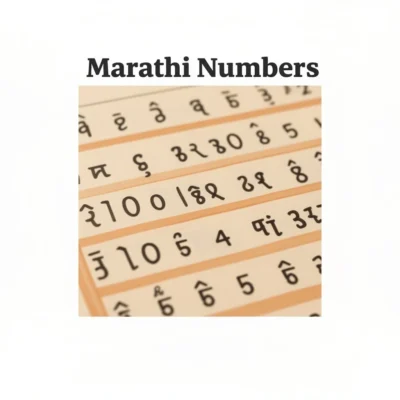
Marathi Numbers 1 to 10: The Foundation
Everything builds from these ten words. Spend extra time here because these appear as roots in larger numbers.
- Ek (एक) – One
- Don (दोन) – Two
- Teen (तीन) – Three
- Chaar (चार) – Four
- Paach (पाच) – Five
- Saha (सहा) – Six
- Saat (सात) – Seven
- Aath (आठ) – Eight
- Nau (नऊ) – Nine
- Daha (दहा) – Ten
The pronunciation of “Don” is not like the English name. It rhymes with “cone” but with a softer “d” sound. “Saha” has equal stress on both syllables. “Nau” sounds like “now” without the “w” ending.
Pro Tip: Record yourself saying these ten words and compare with native speaker audio. The Devanagari script has sounds that do not exist in English, particularly the retroflex consonants in “chaar” and “aath.”
Marathi Numbers 11 to 20: The Irregular Zone
Like most languages, the teens have some quirks. But even here, you will notice patterns emerging.
- Akraa (अकरा) – Eleven
- Baaraa (बारा) – Twelve
- Teraa (तेरा) – Thirteen
- Chaudaa (चौदा) – Fourteen
- Pandhraa (पंधरा) – Fifteen
- Sohlaa (सोळा) – Sixteen
- Satraa (सतरा) – Seventeen
- Athraa (अठरा) – Eighteen
- Ekonis (एकोणीस) – Nineteen
- Vees (वीस) – Twenty
Notice how 11 to 18 end with a similar sound pattern. The “aa” ending is consistent. Nineteen is the odd one out, literally meaning “one less than twenty.” This concept of “ekon” (one less) appears throughout Marathi numbers and is worth remembering.
Marathi Numbers 21 to 100: The Pattern Unlocks
Here is where Marathi gets easier. Numbers 21 to 99 follow consistent rules. You combine the ones digit with the tens digit, similar to English but with Marathi word order.
The Tens Multiples
- 10: Daha (दहा)
- 20: Vees (वीस)
- 30: Tees (तीस)
- 40: Chaalees (चाळीस)
- 50: Pannaas (पन्नास)
- 60: SaaTh (साठ)
- 70: Sattar (सत्तर)
- 80: Ainshi (ऐंशी)
- 90: Navvad (नव्वद)
- 100: Shambhar (शंभर)
Building Compound Numbers
For numbers like 21, 35, 47, the pattern is: ones digit + tens digit. This is the reverse of English. In English you say “twenty-one” (tens first). In Marathi you say “ek-vees” (one-twenty).
Examples:
- 21: Ekvees (एकवीस) – literally “one and twenty”
- 25: Panchvees (पंचवीस) – “five and twenty”
- 32: Battees (बत्तीस) – “two and thirty”
- 38: Adtees (अडतीस) – “eight and thirty”
- 43: Treachaalees (त्रेचाळीस) – “three and forty”
- 47: Sattechaalees (सत्तेचाळीस) – “seven and forty”
- 54: Chopannaas (चोपन्नास) – “four and fifty”
- 59: EkonnsaaTh (एकोणसाठ) – “one less than sixty”
- 66: SahsaaTh (सहासाठ) – “six and sixty”
- 71: Ekasattar (एकसत्तर) – “one and seventy”
- 82: Byaainshi (ब्याऐंशी) – “two and eighty”
- 93: Tryaannavvad (त्र्याण्णव्वद) – “three and ninety”
The numbers ending in 9 are special. Instead of saying “nine and sixty,” Marathi says “one less than sixty” (ekonnsaaTh). This applies to 29, 39, 49, 59, 69, 79, 89, and 99. It is a beautiful linguistic feature that shows how the language thinks about numbers differently.
Pro Tip: When you encounter a compound number you do not know, try breaking it down. Identify the tens multiple first, then figure out which ones digit is attached. Most compound numbers are just the ones digit with a modified tens ending.
Common Pronunciation Challenges
Several sounds trip up English speakers consistently:
- The retroflex “T” in “saaTh” (60) and “sattar” (70). Your tongue should touch the roof of your mouth further back than in English “t.”
- The nasal sounds in “pannaas” (50) and “shambhar” (100). The “n” is pronounced with the tongue against the roof of the mouth.
- The aspirated consonants in “chaalees” (40) and “shambhar” (100). These have a breath of air after the consonant.
Practical Applications: Using Marathi Numbers in Daily Life
Knowing the numbers in isolation is one thing. Using them in real situations is another. Here is how Marathi numbers show up in everyday scenarios.
Shopping and Bargaining
When you are at a market in Pune or Nagpur, you need to understand prices quickly. A vendor might say “don shambhar rupaye” (two hundred rupees). If you only know numbers up to 100, you can still handle most daily transactions, but you need to understand how numbers combine for larger amounts.
The word for hundred is shambhar. Two hundred is don shambhar. Three hundred is teen shambhar. The pattern continues. For thousands, the word is hazaar. So 1,500 would be “deed hazaar paach shambhar” (one and a half thousand five hundred).
Telling Time
Marathi uses numbers for time just like English. “Teen vaajle” means “three o’clock.” “Saade paach” means “half past five” (literally “half five”). “PauNe saat” means “quarter to seven” (literally “quarter less seven”).
Phone Numbers
Phone numbers in India are typically ten digits. When sharing a number, Marathi speakers often group digits in pairs or triplets. Knowing your numbers 0 to 9 fluently is essential here. Zero is shunya (शून्य).
Age and Dates
When someone asks your age, you need numbers. “Mee tees varshacha aahe” means “I am thirty years old.” Dates use numbers extensively. “Paach me” means “May fifth.”
Key Takeaways
- Marathi numbers 1 to 10 are the foundation and appear as roots in larger numbers
- The teens (11 to 20) have some irregular forms but follow a consistent “aa” ending pattern
- Compound numbers from 21 to 99 follow a ones digit + tens digit word order, the reverse of English
- Numbers ending in 9 use the “ekon” prefix meaning “one less than”
- The Devanagari script and Arabic numerals are both used in written Marathi, but spoken words stay the same
- Focus on the tens multiples (10, 20, 30, 40, 50, 60, 70, 80, 90) as anchor points
- Daily practice of 15 minutes can help you master the full system within a week
Frequently Asked Questions About Marathi Numbers
Q: How do you say 100 in Marathi?
A: The word for 100 in Marathi is shambhar (शंभर). It is used as the base for hundreds, so 200 is “don shambhar,” 300 is “teen shambhar,” and so on. The word has a nasal “m” sound that is pronounced with the lips closed.
Q: What is the hardest part about learning Marathi numbers?
A: For most English speakers, the hardest parts are the retroflex consonants and the reversed word order for compound numbers. The retroflex sounds require tongue placement that does not exist in English. The reversed order (ones before tens) takes practice to internalize. Neither is impossible, but both need conscious attention.
Q: Are Marathi numbers the same as Hindi numbers?
A: No, though they share many similarities because both languages descend from Sanskrit. Some numbers are identical, like “teen” (3) and “chaar” (4). Others differ significantly. For example, 20 is “vees” in Marathi but “bees” in Hindi. 50 is “pannaas” in Marathi but “pachaas” in Hindi. If you know Hindi numbers, you have a head start, but you cannot assume they are the same.
Q: How do I write Marathi numbers in Devanagari script?
A: Devanagari uses distinct symbols for each number. One is १, two is २, three is ३, four is ४, five is ५, six is ६, seven is ७, eight is ८, nine is ९, and ten is १०. These symbols are used in formal writing, while Arabic numerals (1, 2, 3) are common in everyday contexts like receipts and newspapers.
Q: What is the fastest way to memorize Marathi numbers?
A: The fastest method is chunking. Learn 1 to 10 completely. Then learn the tens multiples (10, 20, 30, 40, 50, 60, 70, 80, 90). Then practice building compound numbers by combining the ones digit with the tens digit. Use flashcards for the teens, since they are irregular. Practice speaking aloud daily.
Q: Do Marathi speakers use English numbers in conversation?
A: In urban areas and among younger speakers, English numbers are common in casual conversation. However, in rural areas and formal settings, Marathi numbers are standard. If you are learning Marathi seriously, you should know both. Using Marathi numbers shows respect and cultural awareness.
Q: How do you count from 20 to 30 in Marathi?
A: The sequence is: vees (20), ekvees (21), baavees (22), treevees (23), chouvees (24), panchvees (25), savvees (26), sattaavees (27), aaththavees (28), ekontees (29), tees (30). Notice how 29 uses the “ekon” prefix meaning “one less than thirty.”
Q: What is the word for zero in Marathi?
A: Zero is shunya (शून्य) in Marathi. The word comes from Sanskrit and is related to the English word “shunya” used in some mathematical contexts. In everyday speech, people sometimes use the English word “zero” as well.
Q: How do you say 50 in Marathi?
A: Fifty is pannaas (पन्नास) in Marathi. The “nn” represents a doubled nasal consonant. It is distinct from the Hindi word “pachaas.” The Marathi version has a stronger nasal quality and does not have the “ch” sound.
Q: Are Marathi numbers used differently for counting people versus objects?
A: Yes. Marathi has different counting words for people compared to objects. For counting people, you use words like “ek” (one person), “don” (two people), “teen” (three people), and so on. For objects, the same base numbers apply but with different grammatical markers. This is a feature of many Indian languages and takes practice to master.
References & Further Reading
- Omniglot: Marathi Numbers – A comprehensive reference for Marathi numerals in Devanagari script with audio
- Wikipedia: Marathi Language – Background on the language, its speakers, and its script
- University of Chicago: Digital Dictionaries of South Asia – Access to scholarly Marathi dictionaries for deeper study
- Marathi Language Learning Resources from the Maharashtra Government – Official state resources for learning Marathi
—
About This Article: This guide was written based on established Marathi language references and teaching resources. The number systems described follow standard modern Marathi as spoken in Maharashtra. Pronunciation guides are approximations for English speakers and may vary slightly by region. For accurate pronunciation, supplement this guide with audio resources from native speakers.