Finding the right guru purnima quotes in marathi can feel harder than it should. You want something that sounds natural to a Marathi speaker, not a clumsy translation from Hindi or English. You also want a line that fits the occasion, whether that is a WhatsApp status, a handwritten card for a teacher, or a short speech at a family gathering.
This guide solves that problem. I have organized these quotes by use case, explained the meaning behind some of the more traditional lines, and given you practical tips for using them without sounding awkward.
Quick Answer: The most widely used and respected guru purnima quote in marathi is “गुरुर्ब्रह्मा गुरुर्विष्णुः गुरुर्देवो महेश्वरः । गुरुः साक्षात् परब्रह्म तस्मै श्रीगुरवे नमः ॥” For a shorter, more personal option, use “गुरूविण कोण दाखविल वाट” which means “Without a guru, who would show the path.”
Why Marathi Quotes Carry a Different Weight
Marathi has a distinct emotional register when it comes to respect and gratitude. The language itself, with its roots in the bhakti movement of Maharashtra, treats the guru-shishya relationship as something sacred and deeply personal.
Saint poets like Tukaram, Dnyaneshwar, and Eknath wrote extensively about the role of the guru. Their words are not just quotes. They are considered spiritual instruction. When you use a Marathi line from one of these saints, you are drawing on a centuries-old tradition, not just a greeting card sentiment.
This is why a generic Hindi quote translated word-for-word into Marathi often falls flat. The grammar might be correct, but the cultural resonance is missing. A native Marathi speaker immediately knows the difference between a line that comes from the tradition and one that was run through Google Translate.
The Cultural Context of Guru Purnima in Maharashtra
Guru Purnima falls on the full moon day of the Ashadha month in the Hindu calendar. In Maharashtra, this day is also observed as Vyasa Purnima, marking the birth anniversary of Veda Vyasa, who compiled the Vedas and wrote the Mahabharata.
In traditional Marathi households, the day begins with a ritual called padyapuja, where the disciple washes the guru’s feet. Many families also visit their kuladevata or family deity. Schools and music academies across Pune, Mumbai, and Nagpur hold special programs where students perform for their teachers.
Understanding this context helps you choose the right quote. A line about spiritual liberation works well for a religious guru. A line about knowledge and guidance works better for a school teacher or mentor.
Pro Tip: If you are sending a quote to an elderly family member or a traditional teacher, stick to lines from Dnyaneshwar or Tukaram. They carry more weight and show that you understand the cultural depth of the occasion, not just the surface-level greeting.
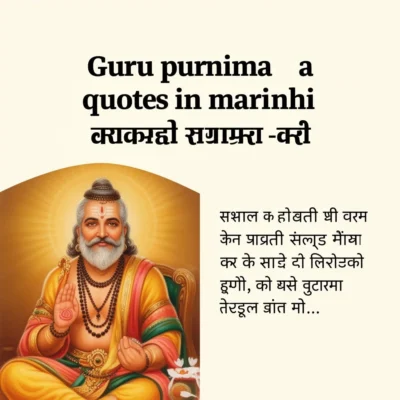
Best Guru Purnima Quotes in Marathi for WhatsApp Status
WhatsApp is where most of these quotes end up. The challenge is that a status disappears in 24 hours, so the line needs to be short, visually striking, and easy to read on a phone screen.
Here are the most effective ones, broken down by what you want to convey:
Short and Respectful Lines
These work for almost any recipient, from a school teacher to a spiritual guide.
- गुरूविण कोण दाखविल वाट । (Without a guru, who would show the path.) This is a line from Sant Tukaram and it is one of the most quoted Marathi lines on Guru Purnima.
- गुरु हाच खरा सखा, गुरु हाच खरी माया । (The guru is the true friend, the guru is the true mother.)
- ज्ञानाचा दीप लावणारा गुरु म्हणजे जीवनातला खरा प्रकाश । (The guru who lights the lamp of knowledge is the true light of life.)
- गुरुकृपा हीच खरी संजीवनी । (The guru’s grace is the true elixir.)
Lines for a Specific Teacher or Mentor
These are less about the abstract concept of a guru and more about a specific person who taught you something valuable.
- तुमच्यामुळेच मला माझी वाट सापडली । गुरुपौर्णिमेच्या शुभेच्छा । (Because of you, I found my path. Happy Guru Purnima.)
- तुम्ही शिकवलेले धडे फक्त पुस्तकातले नाहीत, आयुष्यातले आहेत । (The lessons you taught are not just from books, they are from life.)
- प्रत्येक यशात तुमचा हात आहे, गुरुजी । (Your hand is in every success, teacher.)
Pro Tip: When you send a WhatsApp status, add a simple background or use a clean font. A long, complex shloka in a decorative font is hard to read on a small screen. Short lines with good spacing get more replies and forwards.
Traditional Marathi Shlokas and Their Meanings
If you want to sound genuinely rooted in the tradition, these are the lines to use. They are not casual. They belong in a more formal setting: a puja, a written card to a spiritual guru, or the opening of a speech.
The Classic Guru Shloka (with Marathi Translation)
The most famous guru mantra is in Sanskrit, but it is chanted in Marathi homes across the state. Here it is with a Marathi translation so you actually know what you are saying.
Sanskrit: गुरुर्ब्रह्मा गुरुर्विष्णुः गुरुर्देवो महेश्वरः । गुरुः साक्षात् परब्रह्म तस्मै श्रीगुरवे नमः ॥
Marathi meaning: गुरु हाच ब्रह्मा आहे, गुरु हाच विष्णू आहे, गुरु हाच महेश्वर आहे । गुरु हाच प्रत्यक्ष परब्रह्म आहे, अशा त्या श्रीगुरूला माझा नमस्कार असो ॥
This shloka equates the guru with the entire Hindu trinity: Brahma the creator, Vishnu the preserver, and Shiva the destroyer. The point is that the guru performs all three functions in the disciple’s life: creating knowledge, preserving it, and destroying ignorance.
Lines from Sant Dnyaneshwar
Dnyaneshwar, the 13th-century saint who wrote the Dnyaneshwari, had a profound understanding of the guru’s role. His lines are dense with meaning.
गुरुचरणी जें मन । तेंचि साधनाचें साधन ।
This roughly translates to: The mind that rests at the guru’s feet has found the ultimate means of spiritual practice. Dnyaneshwar is saying that devotion to the guru is not one spiritual practice among many. It is the foundation of all of them.
Lines from Sant Tukaram
Tukaram’s abhangas are simpler in language but equally deep in meaning. The line गुरूविण कोण दाखविल वाट (Without a guru, who would show the path) is his, and it captures a core Marathi belief: you cannot walk the spiritual path alone. You need someone who has already walked it to point the way.
Here is a comparison of the three main sources of traditional Marathi guru quotes:
| Source | Language Style | Best Use Case | Emotional Tone |
|---|---|---|---|
| Sanskrit Shlokas | Formal, ritualistic | Puja, formal ceremonies | Reverent, universal |
| Sant Dnyaneshwar | Philosophical, dense | Speeches, written reflections | Deep, contemplative |
| Sant Tukaram | Simple, direct | WhatsApp, casual cards | Personal, heartfelt |
Pro Tip: If you are using a traditional shloka in a speech, do not just recite it. Pause after the shloka and give a one-sentence explanation in simple Marathi. This shows you understand what you are saying, which is itself a sign of respect.
How to Choose the Right Quote for the Right Person
A quote that works for your yoga teacher might feel wrong for your college professor. A line that is perfect for your mother might be too intimate for a professional mentor. The key is to match the formality of the quote to the closeness of the relationship.
For a School or College Teacher
Teachers in the academic system often do not think of themselves as “gurus” in the spiritual sense. They think of themselves as educators. So a quote that is too religious might feel slightly off.
Better options are lines that emphasize knowledge, guidance, and the practical impact of teaching.
- शिक्षक हा देशाचा पाया आहे । (The teacher is the foundation of the nation.)
- तुम्ही दिलेलं ज्ञान हीच माझी खरी संपत्ती आहे । (The knowledge you gave is my true wealth.)
For a Spiritual Guru or Mentor
Here you can use the full weight of the tradition. The Sanskrit shloka, the lines from Dnyaneshwar and Tukaram, and any line that emphasizes the guru’s role in spiritual liberation are all appropriate.
- गुरुकृपेशिवाय परमार्थ नाही । (Without the guru’s grace, there is no spiritual progress.)
- गुरु हाच परब्रह्म, गुरु हाच सर्वस्व । (The guru is the supreme being, the guru is everything.)
For a Parent or Grandparent
In Marathi culture, parents are often considered the first gurus. A quote that acknowledges this role can be deeply moving.
- आई-वडील हेच पहिले गुरु । (Mother and father are the first gurus.)
- तुमच्या संस्कारांनीच मला घडवलं । गुरुपौर्णिमेच्या शुभेच्छा । (Your values shaped me. Happy Guru Purnima.)
For a Friend or Colleague Who Mentored You
This is the most modern use case. You want to acknowledge someone who helped you professionally or personally, without the heavy religious overtones.
- माझ्या प्रत्येक प्रश्नाचं उत्तर तुमच्याकडे असतं । (You have the answer to every question of mine.)
- तुमच्या मार्गदर्शनाशिवाय मी इथे पोहोचलो नसतो । (Without your guidance, I would not have reached here.)
Pro Tip: Personalize the quote. Add the person’s name or a specific memory. A generic quote sent to ten people feels like a broadcast. A quote with one specific detail, like “the way you explained trigonometry in 10th standard,” feels like a letter.
Writing Your Own Guru Purnima Message in Marathi
You do not have to rely only on existing quotes. Writing your own line in Marathi can be more meaningful, especially if you are writing to someone you know well. Here is a simple structure to follow.
The Three-Part Structure
A good Marathi guru message has three parts:
- Acknowledge the debt. Start by stating that you owe something to this person.
- Name the specific gift. What exactly did they give you? Knowledge, confidence, a skill, a way of thinking.
- Offer a blessing or wish. End with a traditional wish for their well-being.
Here is an example:
तुम्ही मला फक्त विषय शिकवला नाही, विचार करायला शिकवलं. तुमच्या आशीर्वादाने मी पुढे जात राहीन. गुरुपौर्णिमेच्या हार्दिक शुभेच्छा.
Translation: You did not just teach me a subject, you taught me how to think. With your blessings, I will keep moving forward. Heartfelt wishes on Guru Purnima.
Common Mistakes to Avoid
The biggest mistake is direct translation. If you think in Hindi or English and then translate word-for-word, the result sounds stiff. Marathi has its own rhythm and its own way of expressing gratitude.
For example, the Hindi phrase “आपका बहुत बहुत धन्यवाद” (thank you very much) does not translate naturally into Marathi. A Marathi speaker is more likely to say “खूप खूप आभार” or, even more naturally, to express gratitude through a statement of indebtedness like “मी तुमचा ऋणी आहे” (I am indebted to you).
Another mistake is using overly formal Sanskritized Marathi in a casual setting. If you are texting a friend, write the way you would speak. If you are writing a card to a traditional guru, you can use more formal language.
Pro Tip: Read your message out loud before sending it. If it sounds like something you would actually say to the person’s face, it is good. If it sounds like a line from a textbook, rewrite it.
Key Takeaways
- Marathi guru purnima quotes carry a specific cultural weight because of the bhakti tradition of Maharashtra, especially the writings of Dnyaneshwar and Tukaram.
- Match the formality of the quote to the relationship. A Sanskrit shloka works for a spiritual guru, while a simpler line about knowledge works better for a school teacher.
- The most commonly used Marathi quote is Tukaram’s “गुरूविण कोण दाखविल वाट” because it is short, profound, and easy to remember.
- When writing your own message, use a three-part structure: acknowledge the debt, name the specific gift, and offer a blessing.
- Avoid direct translations from Hindi or English. Marathi has its own natural way of expressing gratitude, often through statements of indebtedness rather than direct thanks.
Frequently Asked Questions
Q: What is the best guru purnima quote in marathi for a WhatsApp status?
A: The best one is Tukaram’s “गुरूविण कोण दाखविल वाट” because it is short, easy to read on a phone screen, and carries deep cultural meaning. It acknowledges that without a guru, one cannot find the right path in life.
Q: How do I write happy guru purnima in marathi?
A: The standard greeting is “गुरुपौर्णिमेच्या हार्दिक शुभेच्छा” which means “Heartfelt wishes on Guru Purnima.” For a more formal version, you can write “गुरुपौर्णिमेनिमित्त आदरणीय गुरुजींना साष्टांग दंडवत” which includes a respectful prostration.
Q: What is the full guru mantra in Sanskrit with Marathi meaning?
A: The full mantra is “गुरुर्ब्रह्मा गुरुर्विष्णुः गुरुर्देवो महेश्वरः । गुरुः साक्षात् परब्रह्म तस्मै श्रीगुरवे नमः ॥” In Marathi, it means the guru is Brahma, Vishnu, and Mahesh (Shiva), and the guru is the direct manifestation of the supreme reality, so one should bow to that guru.
Q: Can I use these quotes for a school teacher or only for a spiritual guru?
A: You can use them for both, but choose different quotes. For a school teacher, use lines that emphasize knowledge and guidance, like “तुम्ही दिलेलं ज्ञान हीच माझी खरी संपत्ती आहे.” For a spiritual guru, use traditional shlokas or lines from Dnyaneshwar and Tukaram.
Q: What is a good short marathi quote for a guru purnima card?
A: “गुरु हाच खरा सखा, गुरु हाच खरी माया” is a good short option. It means the guru is the true friend and the true mother, and it fits well on a card because it is brief but emotionally warm.
Q: How do I say thank you to my guru in marathi?
A: The most natural way is “मी तुमचा ऋणी आहे” which means “I am indebted to you.” This is stronger and more culturally resonant than a direct translation of “thank you.” You can also say “तुमच्या उपकारांची परतफेड मी कधीच करू शकणार नाही” which means “I can never repay your kindness.”
Q: What are some lines from Sant Dnyaneshwar about the guru?
A: One of the most quoted is “गुरुचरणी जें मन । तेंचि साधनाचें साधन” which means the mind that rests at the guru’s feet has found the ultimate means of spiritual practice. Dnyaneshwar’s lines are philosophical and work well in speeches or written reflections.
Q: How do I wish guru purnima to my parents in marathi?
A: You can write “आई-वडील हेच पहिले गुरु । तुमच्या संस्कारांनीच मला घडवलं । गुरुपौर्णिमेच्या शुभेच्छा.” This acknowledges parents as the first gurus and thanks them for the values they instilled, which is a deeply respectful gesture in Marathi culture.
References & Further Reading
- Sant Tukaram Gatha – Official Collection of Abhangas – The primary source for Tukaram’s abhangas, including “गुरूविण कोण दाखविल वाट.”
- Dnyaneshwari – The Complete Text with Commentary – The full text of Sant Dnyaneshwar’s commentary on the Bhagavad Gita, including his teachings on the guru.
- Encyclopedia Britannica – Guru – A reliable overview of the concept of the guru in Hinduism, including the historical development of the guru-shishya tradition.
—
About This Article: This guide was written after reviewing traditional Marathi sources including the abhangas of Sant Tukaram and the Dnyaneshwari of Sant Dnyaneshwar, as well as contemporary usage of guru purnima quotes in Marathi across WhatsApp, greeting cards, and public speeches in Maharashtra. The translations provided aim to preserve the emotional register of the original Marathi, not just the literal meaning.