Peer learning meaning in Marathi is समवयस्क अध्ययन (samavayask adhyayan) or सहपाठी शिक्षण (sahpathi shikshan). If you have ever studied with a classmate before an exam, explained a math problem to a friend, or worked on a group project where everyone taught each other something, you have already done peer learning. This article breaks down exactly what peer learning means, how it works in Marathi-medium classrooms and beyond, and why it is one of the most effective ways to actually remember what you study.
Quick Answer: Peer learning meaning in Marathi is समवयस्क अध्ययन. It refers to students of similar age or experience level learning from and with each other, instead of only learning from a teacher. The Marathi term समवयस्क means “of the same age” and अध्ययन means “study or learning.”
What Does Peer Learning Actually Mean?
The phrase has two parts. Peer means someone at your own level, not an authority figure. A peer is a classmate, a colleague, a friend of similar age, or someone with similar experience. Learning here is active, not passive. It is not one person lecturing another. It is a two-way exchange.
In Marathi, the most accurate translation is समवयस्क अध्ययन. Some educators also use सहयोगी शिक्षण (sahayogi shikshan) which means collaborative learning. The concept is not new. Indian classrooms have always had informal peer learning. A student who understands algebra quickly helps a benchmate who is struggling. An older sibling explains a science concept to a younger one. These are all peer learning moments.
The formal definition used in education research is that peer learning is a structured or semi-structured process where people of similar status actively help each other learn. It shifts the source of knowledge from a single teacher to a network of learners.
Pro Tip: Do not confuse peer learning with peer teaching. In peer teaching, one student is assigned the role of “teacher” and the other is “student.” In peer learning, both participants are equal and both learn. The Marathi term समवयस्क अध्ययन captures this equality better than any translation that implies one person instructing another.
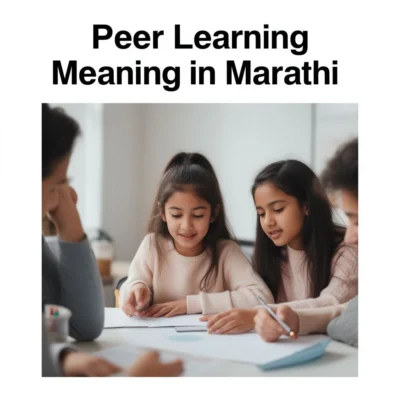
Why Peer Learning Is Gaining Popularity in Marathi-Medium Schools
Maharashtra has seen a significant push toward activity-based learning in the last decade. The State Council of Educational Research and Training (SCERT) Maharashtra has integrated collaborative learning methods into the revised curriculum frameworks. Teachers in Zilla Parishad schools and private Marathi-medium schools are increasingly using group work, pair discussions, and student-led revision sessions.
There is a practical reason for this. Class sizes in many Marathi-medium schools are large. A single teacher cannot give individual attention to 60 or 70 students. Peer learning distributes the teaching load. Students who grasp a concept quickly can help three or four classmates who need more time. This is not a compromise. It is a strategy.
The National Education Policy (NEP) 2020 explicitly emphasizes peer learning as a pedagogical approach. The policy document discusses “peer tutoring” and “collaborative learning” as tools to improve learning outcomes, particularly in foundational literacy and numeracy. For Marathi-medium students, this is significant because it validates a method that many were already using informally at home and in tuition classes.
Common situations where peer learning happens naturally in Marathi-speaking households:
- An older sibling helping with Marathi grammar rules (व्याकरण नियम)
- Classmates preparing for the SSC board exam together
- Friends explaining a difficult poem from the Balbharati textbook to each other
- Study circles at local libraries where students discuss history and geography chapters
The shift now is that schools are making this intentional rather than accidental.
Types of Peer Learning Methods Used in Indian Classrooms
Peer learning is not one single activity. It is an umbrella term that covers several distinct methods. Each works differently and suits different subjects and age groups.
| Method | Marathi Equivalent | How It Works | Best For |
|---|---|---|---|
| Peer Tutoring | सहपाठी शिकवणी | One student with stronger understanding helps a classmate | Math, grammar, science concepts |
| Group Discussion | गटचर्चा | 4-6 students discuss a topic, each sharing what they know | Social science, literature, current affairs |
| Think-Pair-Share | विचार-जोडी-सहभाग | Students think alone, discuss in pairs, then share with class | Any subject, quick concept checks |
| Jigsaw Method | जिगसॉ पद्धत | Each student learns one part, then teaches it to their group | History chapters, science units |
| Reciprocal Teaching | परस्पर शिक्षण | Students take turns leading a discussion using four strategies | Reading comprehension, language learning |
Each of these methods has a different structure, but they share one core principle: the student is active, not passive.
Think-Pair-Share is particularly effective in Marathi-medium classrooms because it requires minimal resources. The teacher poses a question. Students think silently for one minute. They discuss with the person next to them for two minutes. Then selected pairs share their answer with the whole class. No special materials needed. No technology required. Just structured conversation.
The Jigsaw Method works well for long chapters. In a history lesson on Shivaji Maharaj, for example, one student might research his early life, another his military campaigns, another his administration, and another his forts. Each student becomes an “expert” on their section and teaches it to their group. By the end, everyone has learned the full chapter without the teacher lecturing for 45 minutes.
Pro Tip: For Marathi-medium students preparing for competitive exams like MPSC or Scholarship exams, reciprocal teaching in small study groups is far more effective than solo reading. When you have to explain a concept to someone else, you quickly discover what you do not actually understand.
The Science Behind Why Peer Learning Works
There is solid cognitive science behind peer learning. It is not just a feel-good educational trend. When a student explains a concept to a peer, several things happen in the brain.
First, retrieval practice occurs. The student has to pull information from memory, not just recognize it on a page. This strengthens the neural pathways associated with that knowledge. Recognition is easy. Recall is hard. Peer learning forces recall.
Second, elaboration happens. To explain something, you cannot just repeat memorized words. You have to rephrase, give examples, connect it to other concepts. This deepens understanding. A student who can explain a physics principle in simple Marathi to a classmate understands it better than a student who can only recite the textbook definition.
Third, social motivation kicks in. Students do not want to look foolish in front of their peers. This mild social pressure increases focus and effort. It also makes learning feel less isolating. For students who are shy about asking questions in front of a teacher, asking a peer feels much safer.
Research from the University of Michigan’s Center for Research on Learning and Teaching has documented that peer learning improves critical thinking skills and content retention across disciplines. The mechanism is simple: when you teach, you learn twice. The Roman philosopher Seneca said this two thousand years ago, and cognitive science confirms it today.
Key psychological benefits of peer learning:
- Reduced fear of judgment compared to teacher-student interaction
- Immediate feedback loops that help correct misconceptions quickly
- Development of communication skills in the student’s first language
- Increased confidence through successful explanation
- A sense of shared responsibility for group learning outcomes
How Teachers Can Implement Peer Learning in Marathi-Medium Classrooms
Implementing peer learning requires more than just saying “discuss with your partner.” Teachers need a structured approach. Without structure, peer learning sessions can quickly become social time.
Step 1: Create heterogeneous groups. Mix students of different ability levels. If all the strong students sit together, the weaker students do not get the benefit. A common pattern is groups of four with one high performer, two average performers, and one student who needs support.
Step 2: Set a clear learning objective. Every peer learning session needs a specific goal. “Discuss chapter 5” is too vague. “Explain the difference between mitosis and meiosis using diagrams” is specific. The objective should be written on the board in Marathi and English.
Step 3: Provide a time limit. Open-ended discussions lose focus. A good default is 10-15 minutes for group work, followed by a whole-class sharing session. Use a timer. Announce the time remaining periodically.
Step 4: Assign roles within groups. One student is the facilitator (चर्चा प्रमुख), one is the note-taker (लेखक), one is the timekeeper (वेळ पाळक), and one is the presenter (सादरकर्ता). Rotating these roles ensures everyone participates actively.
Step 5: Assess the learning. Peer learning is not a substitute for assessment. After the group activity, use a quick quiz, a written reflection, or a presentation to check understanding. This closes the loop and tells you whether the method worked.
Pro Tip: Start with short, low-stakes peer learning activities. A five-minute think-pair-share is easier to manage than a 40-minute jigsaw session. Build student comfort with the format before increasing complexity. If students have never done structured peer learning before, jumping straight to complex methods will create chaos, not learning.
Challenges and How to Overcome Them
Peer learning is not without problems. Anyone who has tried it in a real classroom knows that.
The dominant student problem. Some students dominate group discussions. Others stay silent. This is common in every classroom, but it is particularly noticeable in peer learning settings where the teacher is not directly controlling the conversation. The solution is structured turn-taking. Use a talking stick or a rule that each student must speak before anyone speaks twice.
The language barrier issue. Many Marathi-medium students think in Marathi but study textbooks that use English terms. Peer learning actually helps here. Students can explain concepts to each other in Marathi, then work together to find the English equivalents. This bilingual processing deepens understanding and improves English vocabulary simultaneously.
The assessment challenge. How do you grade peer learning? It is difficult. A group might produce good work even if one member did nothing. The solution is to combine group assessment with individual assessment. Give a group grade for the collaborative output, but also give individual quizzes to ensure each student actually learned the content.
The time constraint. Peer learning takes longer than direct instruction. Covering the syllabus is a real concern, especially for SSC board exam preparation. The solution is selective implementation. Use peer learning for concepts that students typically find difficult, not for every single topic. Use it for revision and practice, not for first-time introduction of complex material.
Summary: Peer learning in Marathi-medium education works best when it is structured, time-bound, and combined with individual accountability. The challenges are real but manageable with clear systems.
Key Takeaways
- Peer learning meaning in Marathi is समवयस्क अध्ययन, which translates to learning among people of the same age or status.
- The method shifts knowledge flow from a single teacher to a network of students, making it practical for large classrooms.
- Structured methods like think-pair-share, jigsaw, and reciprocal teaching work better than unstructured group discussions.
- Cognitive science supports peer learning because it involves retrieval practice, elaboration, and social motivation.
- Teachers need clear roles, time limits, and assessment strategies to make peer learning effective.
- Peer learning is particularly valuable in Marathi-medium settings because it allows students to process concepts in their first language while building English academic vocabulary.
Frequently Asked Questions About Peer Learning Meaning in Marathi
Q: What is the exact Marathi translation of peer learning?
A: The most common Marathi translation is समवयस्क अध्ययन (samavayask adhyayan). Some educators also use सहपाठी शिक्षण (sahpathi shikshan), which means “learning with classmates.” Both terms refer to the same concept of students learning from and with each other.
Q: Is peer learning the same as group study?
A: Not exactly. Group study can be unstructured, where students simply sit together and read their own notes. Peer learning is structured and interactive, with specific roles, discussion prompts, and a shared learning objective. All peer learning involves some group work, but not all group study qualifies as peer learning.
Q: How can parents support peer learning at home for Marathi-medium students?
A: Parents can encourage their children to form small study groups with classmates. They can create a quiet space for group study, provide simple resources like whiteboards or charts, and ask their child to explain what they learned to a sibling or friend. Even a 15-minute explanation session after school can reinforce learning significantly.
Q: Does peer learning work for competitive exam preparation like MPSC or Scholarship exams?
A: Yes, it is highly effective for competitive exams. Explaining concepts to peers forces you to organize your knowledge and identify gaps. Study circles (अभ्यास मंडळ) have been a traditional part of MPSC preparation culture in Maharashtra for decades. The key is to keep the group focused on active discussion rather than passive reading.
Q: What subjects benefit most from peer learning?
A: Mathematics and science benefit the most because these subjects require problem-solving and conceptual understanding, not just memorization. Language subjects benefit in terms of discussion and interpretation. History and geography work well with jigsaw methods. The method matters more than the subject.
Q: How large should a peer learning group be?
A: The ideal group size is four to five students. Pairs work well for quick activities like think-pair-share. Groups of three can work but often lead to two students talking while one is left out. Groups larger than five become difficult to manage and some students will disengage.
Q: Can peer learning replace teacher instruction entirely?
A: No. Peer learning complements teacher instruction but does not replace it. Teachers are essential for introducing new concepts, correcting misconceptions that peer groups might reinforce, and designing the learning activities. Peer learning is most effective when it follows or precedes direct instruction, not when it replaces it.
Q: What if students give each other wrong information during peer learning?
A: This is a valid concern. The solution is teacher monitoring and a structured debrief session after peer learning activities. Teachers should circulate during group work, listen for misconceptions, and address them in the whole-class discussion that follows. Peer learning without teacher oversight can reinforce errors, so the debrief step is essential.
Q: How is peer learning different from the traditional Gurukul system?
A: The traditional Gurukul system had elements of peer learning, as students of different ages lived and studied together. However, the Gurukul model was primarily teacher-centered, with the guru as the primary source of knowledge. Modern peer learning is more structured and democratic, with students actively constructing knowledge together rather than receiving it from an authority figure.
Q: What resources are available for Marathi-medium teachers who want to implement peer learning?
A: SCERT Maharashtra publishes teacher training materials in Marathi that include collaborative learning strategies. The DIKSHA platform (diksha.gov.in) has Marathi-language resources on activity-based learning. NCERT’s teacher guides also include peer learning activities that can be adapted for Marathi-medium classrooms. Many teachers also share practical strategies through Maharashtra teacher associations and WhatsApp groups.
References & Further Reading
- National Education Policy 2020 – Ministry of Education, Government of India. The policy document discusses peer tutoring and collaborative learning as key pedagogical approaches. Available at education.gov.in.
- SCERT Maharashtra – State Council of Educational Research and Training publishes Marathi-medium teaching resources including collaborative learning modules. Available at scert.maharashtra.gov.in.
- DIKSHA Platform – National digital infrastructure for teacher training with Marathi-language resources on activity-based and peer learning methods. Available at diksha.gov.in.
- University of Michigan Center for Research on Learning and Teaching – Research summaries on peer learning effectiveness and implementation strategies. Available at crlt.umich.edu.
—
About This Article: This guide was written based on research into Marathi-medium education practices, cognitive science literature on collaborative learning, and practical classroom implementation strategies used in Maharashtra schools. The translations and cultural context reflect common usage in Marathi-speaking educational communities. If you found this explanation of peer learning helpful, share it with a teacher or student who could benefit from these methods.