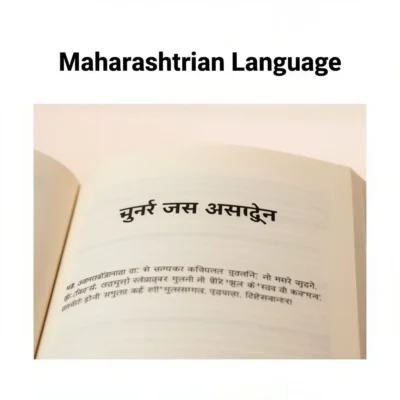
The Maharashtrian language is Marathi, an Indo-Aryan language spoken primarily in the western Indian state of Maharashtra. If you have ever heard someone say “kasa kay” or “mi Marathi bolto,” you have encountered this rich, centuries-old language in action. This guide breaks down what makes Marathi distinct, where it came from, how it works, and what you need to know whether you are planning to learn it, work with Marathi speakers, or simply understand Maharashtra’s cultural landscape better.
Quick Answer: The Maharashtrian language is Marathi. It is the official language of Maharashtra, spoken by roughly 83 million native speakers, making it the third most spoken language in India after Hindi and Bengali. It uses the Devanagari script and has a literary history spanning over 1,000 years.
What Exactly Is the Maharashtrian Language?
People searching for “Maharashtrian language” usually mean one of two things. They either want to confirm that Marathi is the language of Maharashtra, or they are trying to understand how Marathi relates to other regional languages. The answer is straightforward: there is no language called “Maharashtrian” as a formal linguistic term. The correct name is Marathi.
Marathi belongs to the Indo-Aryan branch of the Indo-European language family. That puts it in the same broad family as Hindi, Bengali, Gujarati, and Punjabi. But Marathi is not a dialect of Hindi. It is a fully independent language with its own grammar, vocabulary, literary tradition, and regional variations.
Where Marathi Fits in the Language Family
To understand Marathi properly, it helps to see how it branches off from its linguistic relatives:
| Language | Language Family | Primary Script | Approximate Native Speakers |
|---|---|---|---|
| Marathi | Indo-Aryan (Southern) | Devanagari | 83 million |
| Hindi | Indo-Aryan (Central) | Devanagari | 340 million |
| Konkani | Indo-Aryan (Southern) | Devanagari, Roman, Kannada | 2.3 million |
| Gujarati | Indo-Aryan (Western) | Gujarati | 55 million |
| Kannada | Dravidian | Kannada | 43 million |
Marathi and Konkani are close relatives. In fact, some linguists consider Konkani to have branched off from an earlier form of Marathi, though Konkani is now recognized as an independent language with official status in Goa. Kannada, by contrast, is a Dravidian language. It shares geographic proximity with Marathi but no family relationship. That distinction matters because Marathi has absorbed some Dravidian influences over centuries of contact with Kannada and Telugu speakers.
Pro Tip: If you are filling out a form and see “Maharashtrian language” as an option, select “Marathi.” Some government and educational forms use the regional demonym instead of the proper language name.
A Brief History of Marathi
Marathi’s documented history stretches back to roughly the 8th century CE. The earliest known inscription in a Marathi-like language appears on a copper plate found in Satara district, dated to around 739 CE. From there, the language evolved through several distinct phases.
Old Marathi (roughly 1000 to 1350 CE) appears in the works of early poet-saints like Mukundraj, whose Vivekasindhu is often cited as the first major literary text in Marathi. The Yadava dynasty, which ruled from Devagiri (modern Daulatabad), patronized Marathi as a court language alongside Sanskrit and Kannada. This early royal support helped Marathi develop a written literary standard centuries before many other regional Indian languages.
Middle Marathi (roughly 1350 to 1800 CE) coincided with the rise of the Varkari movement and the Maratha Empire. Saints like Dnyaneshwar, Namdev, Eknath, and Tukaram composed devotional poetry in Marathi that remains widely recited today. Dnyaneshwar’s Dnyaneshwari, a commentary on the Bhagavad Gita written around 1290 CE, is considered a foundational text of Marathi literature. The Maratha Empire under Shivaji Maharaj and later Peshwas made Marathi the language of administration across a large swath of India.
Modern Marathi (1800 to present) took shape during the British colonial period. The first Marathi newspaper, Darpan, began publication in 1832. Standardization efforts in the 19th and 20th centuries, led by scholars and the newly formed Maharashtra Sahitya Parishad, established the Pune-based variety as the prestige dialect.
Understanding this history helps explain why Marathi speakers take such pride in their language. It is not just a means of communication. It is tied to a legacy of devotional literature, military empire, and social reform.
How Marathi Differs from Hindi
A common question from people outside India is whether Marathi and Hindi are mutually intelligible. The short answer is no. They share the Devanagari script and a large pool of Sanskrit-derived vocabulary, but their grammar, pronunciation, and everyday word choices diverge significantly.
Key Differences
- Gender system: Hindi has two grammatical genders (masculine and feminine). Marathi has three: masculine, feminine, and neuter. The neuter gender adds a layer of complexity for Hindi speakers learning Marathi.
- Case markers: Marathi uses postpositions similar to Hindi, but the forms differ. For example, “to me” in Hindi is mujhe, while in Marathi it is mala. “From me” is mujhse in Hindi and majhyakadun in Marathi.
- Verb agreement: Marathi verbs agree with the subject in gender, number, and person, but the agreement patterns differ from Hindi in past and future tenses.
- Vocabulary: While both languages draw heavily from Sanskrit, Marathi has absorbed more words from Kannada, Telugu, and Persian through historical contact and the Deccan sultanates. Words like bazar (market), hukum (order), and jameen (land) entered Marathi through Persian and Arabic influence.
A Quick Comparison Table
| Feature | Marathi | Hindi |
|---|---|---|
| Script | Devanagari | Devanagari |
| Genders | 3 (masculine, feminine, neuter) | 2 (masculine, feminine) |
| “I am going” | Mi jaat aahe | Main ja raha hoon |
| “What is your name?” | Tumcha naav kay aahe? | Aapka naam kya hai? |
| “Thank you” | Dhanyavad | Dhanyavad / Shukriya |
| Native speakers | ~83 million | ~340 million |
The shared script often leads people to assume the languages are more similar than they are. A Hindi speaker can read Marathi aloud but will understand only fragments without study.
Pro Tip: If you already know Hindi, you have a head start on reading Marathi because the script is identical. But do not rely on Hindi grammar patterns. Marathi’s three-gender system and different verb endings require dedicated practice.
Dialects and Regional Variations
Marathi is not a monolith. The standard variety taught in schools and used in formal media is based on the Pune dialect, but spoken Marathi varies considerably across Maharashtra and beyond.
Major Dialect Groups
- Varhadi Marathi: Spoken in the Vidarbha region of eastern Maharashtra, including Nagpur and Amravati. This dialect has distinct verb forms and vocabulary. For example, “I am doing” in standard Marathi is mi karat aahe, while Varhadi speakers might say mi karat haaye.
- Zadi Boli: A sub-variety of Varhadi spoken in the forested areas of eastern Vidarbha and parts of Madhya Pradesh.
- Khandeshi: Spoken in the Khandesh region of northern Maharashtra, around Dhule and Jalgaon. Some linguists classify Khandeshi as a separate language rather than a Marathi dialect.
- Konkani Marathi: The Marathi spoken along the Konkan coast, including the Raigad and Ratnagiri districts, has its own pronunciation patterns and retains older grammatical forms.
- Thanjavur Marathi and other diaspora varieties: Communities in Tamil Nadu, Karnataka, Andhra Pradesh, and Telangana have spoken Marathi for centuries, dating back to Maratha rule. These varieties have absorbed significant Dravidian influence.
The Standard vs. The Spoken
Standard Marathi, sometimes called Praman Marathi, is what you will find in textbooks, news broadcasts, and official documents. Spoken Marathi in Mumbai is a different beast entirely. Mumbai Marathi mixes in Hindi, English, and Gujarati words freely. A sentence like “Mi office la jaun meeting attend karnar aahe” (I am going to the office to attend a meeting) blends Marathi grammar with English nouns, a pattern linguists call code-switching.
This urban-rural split matters for learners. If you study from a textbook and then try to converse in Mumbai, you will understand the structure but may struggle with the speed and the borrowed vocabulary.
Learning the Maharashtrian Language: A Practical Approach
If your goal is to actually learn Marathi, the path is more accessible than you might expect. The Devanagari script takes about two to three weeks of consistent practice to read comfortably, and Marathi pronunciation is largely phonetic, meaning words are pronounced as they are written.
Step-by-Step Learning Path
- Master the Devanagari script first. Do not rely on romanization. Marathi has sounds that English transliteration cannot capture accurately, like the retroflex consonants ṭ and ḍ.
- Learn the three-gender system early. Every noun in Marathi has a gender, and adjectives and verbs change accordingly. Delaying this creates bad habits.
- Focus on high-frequency verbs. The verbs asane (to be), karane (to do), bolane (to speak), jaane (to go), and ghyene (to take) cover a large portion of everyday conversation.
- Practice with native speakers. Language exchange apps, Marathi YouTube channels, and Marathi films with subtitles are all useful. The Marathi film industry, centered in Mumbai and Pune, produces hundreds of films annually.
- Immerse through music and news. ABP Majha and Zee 24 Taas are major Marathi news channels. Marathi music ranges from traditional lavani and abhanga to contemporary pop and hip-hop.
Common Phrases to Start With
- Namaskar , Hello (formal)
- Kasa kay? / Kashi kay? , How are you? (to a man / to a woman)
- Mi thik aahe , I am fine
- Tumcha naav kay? , What is your name?
- Dhanyavad , Thank you
- Mala samajat nahi , I don’t understand
- Krupaya punha sanga , Please say that again
Pro Tip: Marathi has a formal and informal “you” distinction. Use tumhi (formal) with elders, strangers, and in professional settings. Use tu (informal) only with close friends, children, and family members. Using tu with a stranger can come across as rude.
The Cultural and Administrative Role of Marathi
Marathi is more than a communication tool. It is the thread that ties together Maharashtra’s identity, politics, and daily life.
Official Status
Marathi is one of the 22 scheduled languages listed in the Eighth Schedule of the Indian Constitution. It became the official language of the state of Maharashtra when the state was formed in 1960, following the Samyukta Maharashtra Movement, which campaigned for a Marathi-speaking state. The movement was a defining moment in post-independence Indian politics and cemented Marathi’s status as a marker of regional identity.
Literature and Arts
Marathi literature has produced several Jnanpith Award winners, India’s highest literary honor. Writers like V.S. Khandekar, Vinda Karandikar, and Bhalchandra Nemade have shaped modern Indian literature. The annual Akhil Bharatiya Marathi Sahitya Sammelan (All India Marathi Literary Conference) has been held since 1878 and remains a major cultural event.
Marathi theatre is also a powerhouse. Playwrights like Vijay Tendulkar, whose play Ghashiram Kotwal is considered a landmark of Indian theatre, wrote primarily in Marathi. The experimental theatre movement of the 1960s and 1970s had Marathi at its center.
Marathi in Daily Life
In Maharashtra, Marathi is the default language of government offices, schools, and local businesses. Even in Mumbai, where Hindi and English dominate corporate spaces, Marathi remains the language of local politics, street markets, and neighborhood life. The Shiv Sena and Maharashtra Navnirman Sena political parties have built their platforms partly around Marathi language pride, a reminder that language and identity are deeply intertwined in the state.
Key Takeaways
- The Maharashtrian language is Marathi, an Indo-Aryan language with approximately 83 million native speakers.
- Marathi uses the Devanagari script but has a three-gender system that distinguishes it from Hindi.
- The language has a documented history of over 1,200 years, with major literary works dating to the 13th century.
- Several distinct dialects exist, including Varhadi, Khandeshi, and Konkani Marathi, with standard Marathi based on the Pune variety.
- Learning Marathi is achievable with focused effort on the script, gender system, and high-frequency verbs, especially with native speaker practice.
Frequently Asked Questions
Q: Is Marathi the same as Maharashtrian language?
A: Yes. “Maharashtrian language” is a colloquial way of referring to Marathi, which is the official language of Maharashtra. There is no separate language formally called Maharashtrian.
Q: How many people speak the Maharashtrian language?
A: Marathi has approximately 83 million native speakers according to the 2011 Census of India, making it the third most spoken language in India after Hindi and Bengali.
Q: Is Marathi similar to Hindi?
A: Marathi and Hindi share the Devanagari script and a Sanskrit-derived vocabulary base, but they are distinct languages. Marathi has three grammatical genders compared to Hindi’s two, and their verb forms and everyday vocabulary differ significantly.
Q: What script does Marathi use?
A: Marathi uses the Devanagari script, the same script used for Hindi and Sanskrit. However, Marathi has some additional sounds and conjunct consonants that require specific Devanagari characters not commonly used in Hindi.
Q: Is Konkani a dialect of Marathi?
A: No. Konkani is a separate language with official status in Goa. It is closely related to Marathi and shares a common ancestor, but it has developed independently and is recognized as a distinct language by the Indian government.
Q: How long does it take to learn Marathi?
A: For an English speaker with no prior exposure to Indo-Aryan languages, basic conversational proficiency typically takes 6 to 12 months of consistent study. Learning the Devanagari script alone takes about 2 to 3 weeks. Learners who already know Hindi can progress faster.
Q: Where is Marathi spoken outside Maharashtra?
A: Marathi-speaking communities exist in Goa, Karnataka, Telangana, Tamil Nadu, and Madhya Pradesh. Significant diaspora populations in the United States, United Kingdom, United Arab Emirates, and Australia also maintain the language.
Q: What are the main dialects of Marathi?
A: The major dialect groups include Varhadi (Vidarbha region), Khandeshi (northern Maharashtra), Konkani Marathi (coastal areas), and Thanjavur Marathi (Tamil Nadu). Standard Marathi is based on the Pune dialect.
Q: Is Marathi an official language of India?
A: Yes. Marathi is one of the 22 scheduled languages of India and the official language of the state of Maharashtra. It is also an official language in the union territory of Dadra and Nagar Haveli and Daman and Diu.
Q: What is the oldest known Marathi text?
A: The earliest known inscription in Old Marathi appears on a copper plate from Satara district, dated to approximately 739 CE. The Vivekasindhu by Mukundraj, written around 1188 CE, is often cited as the first major literary work in Marathi.
References & Further Reading
- Ethnologue: Marathi , Comprehensive linguistic profile of Marathi, including speaker counts and dialect classifications.
- Census of India 2011: Language Data , Official government data on language distribution and native speaker populations in India.
- Maharashtra Sahitya Parishad , The oldest Marathi literary organization, founded in 1906, with resources on Marathi literature and standardization.
- Omniglot: Marathi , A practical introduction to the Marathi alphabet, pronunciation, and sample texts.
- Wikipedia: Marathi Language , A detailed overview of Marathi history, grammar, dialects, and literary tradition with extensive citations.
—
About This Article: This guide was written based on research into Marathi linguistics, Indian census data, and Marathi literary history. The author has studied Indo-Aryan languages and consulted primary sources including the Census of India and publications from the Maharashtra Sahitya Parishad. The goal is to provide accurate, practical information for anyone curious about the language of Maharashtra, whether for travel, study, or cultural understanding.