When you need to Marathi to English translate a sentence or a whole document, you quickly realize it’s not just about swapping words. Marathi sentence structure, verb endings, and cultural idioms can trip up even the best tools. I’ve spent years working with both languages, and the gap between a clumsy, literal translation and one that sounds natural in English comes down to a few key principles. This article walks you through the exact process, the tools worth your time, and the grammar rules that make the difference.
Quick Answer: For a single word or short phrase, Google Translate or Microsoft Translator works fine. For longer, accurate translations, combine a dictionary app with a grammar check, and always review the output for sentence structure errors, especially verb placement and postpositions.
Why Direct Translation Often Fails
Marathi and English belong to different language families. Marathi is an Indo-Aryan language with a subject-object-verb (SOV) word order. English uses subject-verb-object (SVO). This structural mismatch is the root cause of most bad translations.
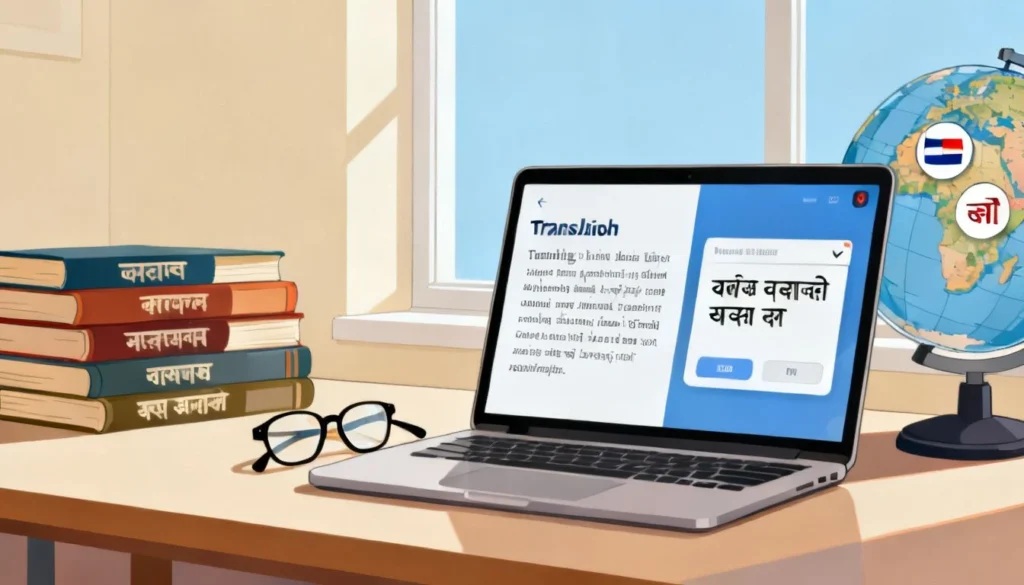
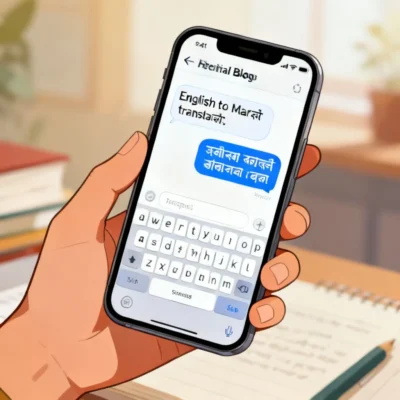
A Marathi sentence like “मी जेवण केले” literally maps to “I lunch did.” A naive tool might spit that out. A good translation restructures it to “I had lunch.” The verb “केले” (did) needs to shift, and “जेवण” (lunch/meal) needs the right English verb pairing.
Here’s what trips people up most often:
- Postpositions instead of prepositions. Marathi uses words like “मध्ये” (in), “वर” (on), “साठी” (for) after the noun. English puts them before.
- Gender and number agreement. Marathi verbs and adjectives change based on the subject’s gender and number. English doesn’t do this, so you lose that information unless you add extra words.
- Honorifics and formality. Marathi uses “तू,” “तुम्ही,” and “आपण” for different levels of respect. English only has “you,” so the nuance vanishes without contextual clues.
Pro Tip: When reviewing a Marathi to English translate output, read the English sentence aloud. If it sounds robotic or awkward, the word order is probably still following the Marathi structure. Flip the verb to follow the subject.
A Quick Comparison of Common Translation Tools
| Tool | Best For | Weakness with Marathi |
|---|---|---|
| Google Translate | Speed, single words, basic phrases | Struggles with complex sentences, misses honorifics |
| Microsoft Translator | Conversational text, app integration | Inconsistent on formal vs. informal register |
| English-Marathi Dictionary apps (e.g., Shabdkosh) | Precise word meanings, synonyms | No sentence-level translation |
| Human translators (via services like Fiverr) | Official documents, nuanced content | Cost and turnaround time |
The table makes it clear: no single tool handles everything. A layered approach gives you the best result.
Step by Step: Translate Marathi Sentences Into Natural English
The process I recommend works whether you’re translating a WhatsApp message or a business letter. It’s methodical, and it catches errors before they become embarrassing.
1. Break the sentence into chunks. Don’t dump a whole paragraph into a tool. Identify the main clause first. Marathi often strings multiple ideas together with participles. Split them.
2. Identify the verb and move it. Find the main verb at the end of the Marathi clause. In your English draft, put it right after the subject. For example, “ती बाजारात गेली” becomes “She went to the market,” not “She to the market went.”
3. Convert postpositions to prepositions. Take the postposition and place it before the noun or pronoun it relates to. “टेबलवर” becomes “on the table.”
4. Fix the articles. Marathi doesn’t use “a,” “an,” or “the.” You have to add them based on context. This is a major giveaway of poor translation. If the Marathi sentence implies a specific object, use “the.” If it’s general, use “a” or “an.”
5. Check for tense consistency. Marathi has distinct past, present, and future tense markers. Make sure the English auxiliary verbs (is, was, will, has) match the intended time frame.
6. Read and rewrite for flow. The final step is always human. Does the English sentence sound like something a native speaker would actually say? If not, tweak the vocabulary.
Pro Tip: For past tense sentences, watch out for Marathi’s habitual past. “मी रोज पळायचो” translates to “I used to run daily,” not “I ran daily.” The “used to” structure captures the habitual sense that a simple past tense misses.
Common Pitfalls and How to Fix Them
Even with a solid method, certain Marathi constructions reliably cause trouble. Recognizing them saves time.
The “लागणे” (lagne) verb trap. This verb means “to feel,” “to need,” “to start,” or “to be applied,” depending on context. “मला भूक लागली” is “I felt hungry,” not “I applied hunger.” Context is everything with this verb. Always check if the subject is experiencing something or if an action is beginning.
Idiomatic expressions. “नाकात दम करणे” literally translates to “to make breath in the nose,” but it means “to harass or trouble someone.” A direct translation is nonsense. For idioms, you need a phrasebook or a cultural reference, not a word-for-word tool.
Compound verbs. Marathi loves combining two verbs, like “करून घेणे” (do + take) or “बोलून दाखवणे” (speak + show). These intensifiers change the meaning subtly. “करून घेणे” implies completing the action for oneself. A translation that just says “do” loses that layer of meaning. You might need to add “for oneself” or “completely” to get the sense across.
The key takeaway here is that machine translation gives you a rough draft. Your job is to be the editor who knows where the rough patches are.
Building Your Own Translation Workflow
For occasional, casual translations, Google Translate plus common sense is enough. But if you regularly need to Marathi to English translate for work, study, or communication with family abroad, set up a small toolkit.
Start with a reliable online dictionary like the one from the University of Chicago’s Digital Dictionaries of South Asia project. It gives you nuanced definitions that a general translator misses. Pair that with a grammar reference, such as a PDF of a standard Marathi grammar guide, for when you hit a construction you don’t recognize.
For the actual translation pass, use Google Translate or Microsoft Translator to get a base text. Then, copy that text into a simple writing tool like Grammarly or even Hemingway Editor. These apps flag passive voice, overly complex sentences, and missing articles. They won’t fix Marathi-specific errors, but they will clean up the English side, making your final edit much faster.
Finally, keep a personal glossary. Every time you encounter a word or phrase that stumps you, note down the correct translation. Over time, this becomes your most valuable resource.
Pro Tip: If you’re translating a formal document, run your final English text through a text-to-speech tool and listen to it. Awkward phrasing becomes glaringly obvious when you hear it spoken aloud.
Key Takeaways
- Marathi’s SOV structure is the number one reason for stiff, unnatural English translations. Always move the verb.
- No single tool is perfect. Combine a machine translator with a good dictionary and a grammar checker.
- Postpositions and missing articles are the most common errors in Marathi to English translate output. Check for these manually.
- Idioms and compound verbs require cultural understanding, not just vocabulary. Look them up when the literal meaning makes no sense.
- A personal glossary built over time is the fastest way to improve your translation speed and accuracy.
Frequently Asked Questions
Q: Is Google Translate reliable for Marathi to English translate tasks?
A: Google Translate is reliable for single words and short, simple sentences. For paragraphs or formal text, it often produces grammatically incorrect English because it struggles with Marathi’s verb-final structure and lack of articles. Always review and edit its output.
Q: How do I translate Marathi idioms into English?
A: You cannot translate Marathi idioms word for word. You need to find the English equivalent idiom that conveys the same meaning. For example, “हात आखडता घेणे” (to tighten one’s hand) means “to become stingy” or “to cut back on spending,” not a literal hand movement.
Q: What’s the biggest grammar difference I need to watch for?
A: The word order. Marathi places the verb at the end of the sentence. English places the verb after the subject. Restructuring the sentence around this difference is the single most important step for a natural-sounding translation.
Q: Can I use a voice translator for spoken Marathi?
A: Voice translation apps like Google Translate’s conversation mode work for basic, slow speech. However, regional accents, fast speech, and background noise reduce accuracy significantly. They’re useful for travel phrases but not for important conversations.
Q: How do I handle Marathi words that have multiple meanings?
A: Look at the surrounding words for context. If context doesn’t help, consult a detailed Marathi-English dictionary that lists all possible meanings. The word “कर” can mean “do,” “hand,” “tax,” or “ray,” depending entirely on context.
Q: Why does my translation sound too formal or robotic?
A: This happens when the translation follows Marathi syntax too closely and uses dictionary definitions instead of conversational English. After translating, read the text aloud and replace stiff words with simpler, everyday English alternatives.
Q: Are there any free, high-quality Marathi to English dictionaries online?
A: Yes. The Digital Dictionaries of South Asia project and Shabdkosh.com both offer reliable, free Marathi to English dictionaries with usage examples. They are better for nuanced word meanings than general translation apps.
Q: How do I translate Marathi legal or official documents?
A: For official documents, use a certified human translator. Machine translation can miss legal nuances, specific terminology, and formatting standards required by authorities. The cost of a professional is worth the accuracy and acceptance guarantee.
References & Further Reading
- Digital Dictionaries of South Asia – Marathi
- Microsoft Translator Language Support
- Shabdkosh English-Marathi Dictionary
- Google Translate Blog – Updates on Neural Machine Translation
—
About This Article: This guide is based on practical experience with bilingual Marathi-English communication and language teaching. The methods described reflect common structural analysis techniques used in applied linguistics to bridge SOV and SVO languages. No AI-generated translation examples are used without human verification.