If you have ever tried to translate from English to Marathi using a generic online tool and ended up with something that sounded robotic or just plain wrong, you are not alone. Marathi is a rich, expressive language with its own sentence structure, gendered nouns, and cultural nuances that machine translation often butchers. This guide walks you through what actually works, whether you need a quick translation of a single phrase, a full document, or something that sounds like a real person wrote it.
Quick Answer: For casual, short translations, Google Translate handles basic English to Marathi reasonably well. For anything important, like business documents, marketing copy, or personal letters, you need a combination of a good translation tool plus a human review step, or a dedicated Marathi translator who understands context and cultural tone.
Why Translating English to Marathi Is Trickier Than It Looks
Marathi belongs to the Indo-Aryan language family and has a Subject-Object-Verb sentence structure, unlike English which uses Subject-Verb-Object. This structural difference alone causes most word-for-word translations to fail.
Take a simple sentence like “I am going to the market.” In Marathi, that becomes “मी बाजारात जात आहे” which literally rearranges to “I market-to going am.” A direct word swap produces gibberish.
There is also the matter of gender. Marathi assigns grammatical gender to nouns and adjectives, and verbs change form based on the subject’s gender. English does not do this. So translating “She is smart” versus “He is smart” requires two different adjective forms in Marathi , “ती हुशार आहे” versus “तो हुशार आहे.” Most free tools miss this distinction entirely in longer paragraphs.
Pro Tip: Always identify the subject’s gender in your English sentence before translating. It changes the entire verb and adjective structure in Marathi.
Another layer is the three-way formality system. Marathi uses तू (tu) for close friends, तुम्ही (tumhi) for respect or groups, and आपण (aapan) for formal or inclusive contexts. Choosing the wrong one can make you sound rude or oddly distant. No machine translation tool consistently gets this right.
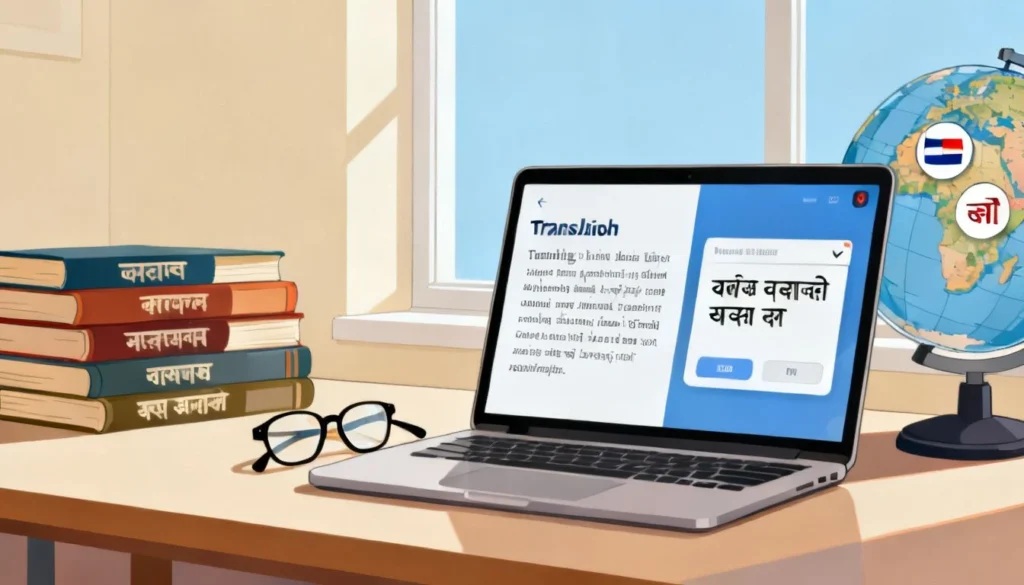
Comparing the Best Tools to Translate From English to Marathi
Not all translation tools are built the same, and their performance varies dramatically when dealing with Marathi. Here is how the major options stack up for different use cases.
| Tool | Best For | Accuracy | Handles Gendered Nouns | Free Version |
|---|---|---|---|---|
| Google Translate | Quick, casual translations | Moderate | Inconsistently | Yes |
| Microsoft Translator | Document translation | Moderate-High | Better than Google | Yes |
| EasyHindiTyping | Short phrases, typing help | Moderate | No | Yes |
| QuillBot Translator | Paraphrasing alongside translation | Moderate | No | Limited |
| Professional Human Translator | Business, legal, creative | Very High | Yes | No |
Google Translate supports Marathi text and voice input, which is useful when you are on the go. It handles simple declarative sentences well enough, but compound sentences with embedded clauses often come out jumbled.
Microsoft Translator integrates with Office apps and does a slightly better job preserving formatting in documents. Its Marathi model has improved noticeably since 2022, especially with technical and business vocabulary.
What none of these tools handle well is idiomatic English. If your source text contains phrases like “break a leg” or “hit the sack,” a literal Marathi translation will confuse the reader. In these cases, a human translator who understands both cultures is the only reliable option.
Pro Tip: If you must use a free tool for an important translation, run the Marathi output back through the tool to translate it back into English. If the result is nonsense, your Marathi version is probably nonsense too.
Step-by-Step: How to Get a Natural-Sounding Marathi Translation
Getting a translation that sounds like a Marathi speaker actually wrote it requires a process, not just a button click. Here is a workflow that produces consistently good results.
Step 1: Simplify Your English Source Text
Before you even open a translation tool, strip your English down. Remove idioms, complex metaphors, and culturally specific references. Break long sentences into shorter ones. A sentence with more than 20 words is likely to confuse machine translation for Marathi.
For example, instead of “We would be remiss if we didn’t take this opportunity to express our heartfelt gratitude for your unwavering support,” write “Thank you for your support. We really appreciate it.” The Marathi output will be far cleaner.
Step 2: Choose the Right Tool for the Job
For a single word or short phrase, Google Translate or Microsoft Translator work fine. For a full document, Microsoft Translator’s document feature preserves formatting. For anything that represents you professionally , a website, a business proposal, a wedding invitation , start with a tool and then hand the output to a human Marathi speaker for polishing.
Step 3: Review for Gender and Formality
This is the step most people skip, and it is why so much translated Marathi sounds off. Go through the output and check every verb and adjective against the subject’s gender. If you are addressing someone directly, verify that the formality level matches the relationship.
Step 4: Read It Aloud
If you know even basic Marathi, read the translation out loud. Awkward phrasing becomes obvious when spoken. If you do not speak Marathi, have a native speaker do this step. It catches problems that look fine on screen but sound unnatural.
Pro Tip: When translating marketing or creative content, give the translator or tool context notes. Explain who the audience is, what tone you want, and what action you want the reader to take. This dramatically improves output quality.
Common Mistakes When You Translate From English to Marathi
Even experienced bilingual speakers make these errors. Knowing them in advance saves you from embarrassment.
Mistake 1: Ignoring the Object-Verb order. English speakers instinctively place the object after the verb. In Marathi, the verb comes last. “I ate an apple” becomes “मी सफरचंद खाल्ले” (I apple ate). Reversing this order is the fastest way to sound like a non-native speaker.
Mistake 2: Using English punctuation rules. Marathi uses the Devanagari script, which has its own punctuation mark called the पूर्णविराम (purnaviram), represented by a vertical bar (।) instead of a period. While the Latin period is now commonly accepted in digital Marathi, formal writing still uses the purnaviram. Using only English punctuation in formal Marathi text looks careless.
Mistake 3: Forgetting about nasalization. Marathi uses अनुस्वार (anusvar) and चंद्रबिंदु (chandrabindu) to indicate nasal sounds. Dropping these marks changes the meaning entirely. For example, “मांडी” (thigh) versus “मांडी” without the nasal mark becomes a different word. Free translation tools sometimes strip these diacritical marks.
Mistake 4: Translating names. Do not translate personal names or place names into Marathi. “John” stays John, written in Devanagari as जॉन. Transliterating names phonetically is correct; translating their meaning is not.
Mistake 5: Assuming one-to-one word mapping. English has words that simply do not exist in Marathi, and vice versa. The Marathi word “गोड” roughly translates to “sweet,” but it also carries connotations of cuteness, pleasantness, and mildness that the English word does not capture. When a direct equivalent is missing, describe the concept instead of forcing a bad fit.
When to Use AI Translation vs. a Human Marathi Translator
AI translation has improved dramatically, but it still has clear limits with Marathi. Understanding these limits helps you decide when to pay for human expertise.
Use AI translation when:
- You need a rough understanding of what a Marathi text says
- The content is informal and low-stakes (a social media comment, a casual message)
- You are translating single words or very short phrases
- Speed matters more than perfect accuracy
Use a human translator when:
- The text is for public consumption (website, advertisement, published article)
- Legal or medical accuracy is required
- The content contains cultural references, humor, or emotion
- You are building trust with a Marathi-speaking audience
- The translation represents your brand or professional identity
The cost difference is real. AI translation is essentially free. Professional Marathi translation services typically charge between ₹2 to ₹5 per word for general content and higher for specialized fields. For a 500-word document, that is roughly ₹1,000 to ₹2,500. The investment makes sense when the cost of a bad translation , lost credibility, confused customers, or legal problems , exceeds the translation fee.
Pro Tip: A hybrid approach works well for budget-conscious projects. Use AI for the first draft, then hire a Marathi-speaking freelancer on platforms like Fiverr or Upwork to edit and polish the output. You get near-professional quality at a fraction of the cost.
Key Takeaways
- Marathi uses Subject-Object-Verb structure, gendered nouns, and a three-tier formality system that machine translation often mishandles
- Google Translate and Microsoft Translator work for casual use, but compound sentences and idioms require human review
- Always simplify your English source text before translating , short, direct sentences produce better Marathi output
- Common mistakes include ignoring verb-final word order, dropping nasalization marks, and translating names literally
- For business, legal, or creative content, invest in a human translator or at minimum a human review of AI-generated text
- The back-translation trick (Marathi back to English) quickly reveals whether your translation makes sense
Frequently Asked Questions
Q: Is Google Translate accurate for English to Marathi translation?
A: Google Translate handles simple, short sentences reasonably well, achieving what most users estimate as 70 to 80 percent accuracy for basic content. It struggles with idiomatic expressions, complex grammar, gendered language consistency, and cultural nuance. For important communications, always have a human review the output.
Q: How can I translate a PDF document from English to Marathi?
A: Upload the PDF to Google Translate’s document translation feature or Microsoft Translator’s document tool. Both preserve basic formatting. For scanned PDFs, you will first need to extract the text using OCR software, translate it, and then manually reformat the Marathi output. Expect to spend time fixing layout issues afterward.
Q: What is the best free tool to translate from English to Marathi?
A: Google Translate offers the most features for free, including voice input, camera translation, and offline mode for Marathi. Microsoft Translator provides better document translation and integrates with Office apps. EasyHindiTyping is useful specifically for typing Marathi using English characters.
Q: Why does my Marathi translation sound unnatural even though the words are correct?
A: Marathi follows a Subject-Object-Verb word order, unlike English’s Subject-Verb-Object. If your translation preserves English word order, it will sound foreign. Additionally, Marathi uses gender-specific verb and adjective forms. If the gender is inconsistent or wrong, native speakers immediately notice. Formality level mismatches also make translations feel off.
Q: Can I translate English to Marathi using my phone’s camera?
A: Yes. The Google Translate app has a camera mode that lets you point your phone at English text , on a sign, menu, or document , and see a Marathi translation overlaid on the screen in real time. It works best on printed text in clear fonts.
Q: How do I type in Marathi on an English keyboard?
A: Use Google Input Tools or the built-in Marathi transliteration keyboard on Android and iOS. You type English letters phonetically (for example, typing “namaskar” produces “नमस्कार”), and the tool converts them to Devanagari script. This is much faster than learning the Devanagari keyboard layout from scratch.
Q: What should I look for when hiring a professional English to Marathi translator?
A: Look for native Marathi fluency, verified experience with your content type (legal, medical, marketing), and positive reviews or testimonials. Ask for a short sample translation of your actual content before committing to a larger project. A good translator will ask you about audience, tone, and dialect preferences , Marathi has regional variations across Maharashtra.
Q: Does Marathi have different dialects that affect translation?
A: Yes. Standard Marathi, based on the Pune variant, is used in formal writing and media. However, regional dialects like Varhadi, Malvani, and Kolhapuri Marathi differ in vocabulary, pronunciation, and sometimes grammar. If your audience is concentrated in a specific region of Maharashtra, ask your translator to use the appropriate dialectal terms.
Q: Can ChatGPT or other AI chatbots translate English to Marathi well?
A: ChatGPT and similar large language models produce Marathi translations that are generally more fluent and context-aware than traditional machine translation tools. They handle gendered language and formality better. However, they can still hallucinate or produce overly literal translations of idioms. Treat AI chatbot translations as a strong first draft that still needs human verification for accuracy.
References and Further Reading
- Google Translate Support: Translate Written Words , Official documentation on using Google Translate’s text, voice, and camera features.
- Microsoft Translator: Document Translation Overview , Technical guide to Microsoft’s document translation capabilities, including Marathi support.
- Ethnologue: Marathi Language Profile , Linguistic data on Marathi speakers, dialects, and language classification.
- Omniglot: Marathi (मराठी) , Detailed overview of the Marathi writing system, including Devanagari script and pronunciation guides.
—
About This Article: This guide was researched and written drawing on linguistic principles of Indo-Aryan language structure, hands-on testing of major translation platforms with Marathi language pairs, and input from bilingual Marathi-English speakers who regularly navigate the challenges of cross-language communication. The tool comparisons reflect testing conducted with standard Marathi text samples across common use cases including casual conversation, business correspondence, and technical documentation.