Where is Marathi spoken? If you are planning a trip, moving for work, or just curious about India’s linguistic map, the short answer is that Marathi is the official language of Maharashtra, the third largest state in India by area. But the real answer is more interesting. Marathi spills across state borders, follows migrant communities, and has pockets of speakers on multiple continents.
This guide breaks down every major region where you will hear Marathi, from the streets of Mumbai to diaspora communities in New Jersey and London.
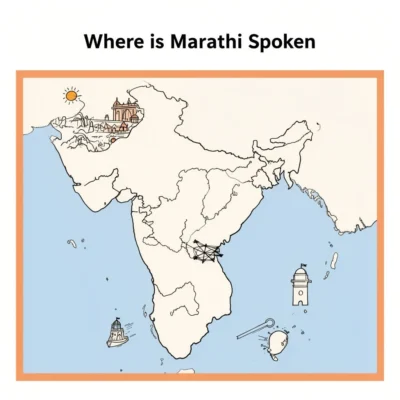
Quick Answer: Marathi is spoken primarily in Maharashtra, India, where it is the official state language. It is also widely spoken in the neighboring states of Goa, Karnataka, Telangana, Gujarat, and Madhya Pradesh, especially in districts that border Maharashtra. Globally, significant Marathi-speaking communities exist in Israel, the United States, the United Kingdom, and the Gulf states.
—
Maharashtra: The Heartland of Marathi
Maharashtra is where the language lives and breathes at full volume. Over 83 million people in India reported Marathi as their mother tongue in the 2011 Census of India, and the overwhelming majority of them live in this single state.
Within Maharashtra, Marathi is not just an official language. It is the language of government, education, courts, newspapers, and daily commerce. The state is home to several distinct regional dialects that sound noticeably different from one another:
- Varhadi Marathi, spoken in the Vidarbha region around Nagpur and Amravati
- Zadi Boli, a rural dialect from the eastern forests of the state
- Konkani-influenced Marathi along the coastal Konkan belt
- Standard Marathi, based on the Pune variety, used in media and formal writing
Mumbai deserves its own mention. The city is a linguistic pressure cooker where Marathi coexists with Hindi, Gujarati, Urdu, and English. Despite that mix, Marathi remains the official language of the Brihanmumbai Municipal Corporation and the Government of Maharashtra, and it is the first language of roughly 42% of Mumbai’s population. Walk into any local train station, municipal office, or neighborhood market in Dadar or Girgaon, and Marathi is the default.
Pro Tip: If you are learning Marathi, aim for the Pune or Mumbai standard. That is the variety used on Marathi news channels like ABP Majha and Zee 24 Taas, and it will make you understood everywhere from Kolhapur to Nagpur.
This is the core answer to where Marathi is spoken. But the language does not stop at the state line.
—
Border Districts in Neighboring States
Maharashtra’s political borders were drawn in 1960, but linguistic borders never match political ones perfectly. Marathi has been spoken for centuries in areas that now belong to other states.
Goa
Goa’s relationship with Marathi is deep and sometimes contested. Konkani is Goa’s official state language, but Marathi has a long history as a literary and administrative language in the region. Many older Goans, especially those educated before 1961, read and write Marathi fluently. The Gomantak Marathi Academy works to promote the language in the state, and Marathi is still used in some newspapers and cultural organizations.
Karnataka
The districts of Belagavi (Belgaum), Bidar, and Uttara Kannada have substantial Marathi-speaking populations. Belagavi is the flashpoint. The Maharashtra Ekikaran Samiti has campaigned for decades to merge Marathi-speaking border areas of Karnataka into Maharashtra. Depending on the taluka, Marathi speakers make up anywhere from 30% to over 70% of the local population in some border pockets. The city of Belagavi itself has a visible Marathi presence in its signage, schools, and cultural institutions.
Telangana and Andhra Pradesh
The old Nizam’s Dominion of Hyderabad included several Marathi-speaking districts, and that legacy remains. Areas like Adilabad, Nizamabad, and Medak in Telangana still have Marathi-speaking communities, particularly in rural areas close to the Maharashtra border.
Gujarat and Madhya Pradesh
In Gujarat, the districts of Valsad, Navsari, and Surat have Marathi-speaking pockets, especially among communities that migrated for work in textiles and diamond polishing. In Madhya Pradesh, the districts of Betul, Chhindwara, Balaghat, and Burhanpur all have significant Marathi populations, a legacy of the old Nagpur kingdom and the Central Provinces.
Here is a quick comparison of where Marathi holds official or semi-official status versus where it is simply widely spoken:
| Region | Status of Marathi | Approximate Speaker Presence |
|---|---|---|
| Maharashtra | Official state language | Over 80 million |
| Goa | Recognized for official use in some contexts | Several hundred thousand |
| Dadra and Nagar Haveli and Daman and Diu | Widely spoken, used in administration | Majority of local population |
| Belagavi, Karnataka | No official status, strong cultural presence | 30-70% in border talukas |
| Border districts of Telangana, Gujarat, MP | No official status | Scattered communities |
The takeaway is simple: if you are anywhere within 100 kilometers of Maharashtra’s border, you will likely find Marathi speakers without much effort.
—
Union Territories and the Konkan Belt
Beyond the states, Marathi has a strong foothold in several Union Territories along the western coast.
Dadra and Nagar Haveli and Daman and Diu is the most Marathi-speaking Union Territory in India. The territory was under Portuguese rule until 1961, but the local population largely spoke Marathi and Gujarati. Today, Marathi is used in local administration, schools, and daily life. In the 2011 Census, Marathi speakers formed the single largest linguistic group in the territory.
The Konkan region deserves special attention. This coastal strip runs from Mumbai down through Ratnagiri and Sindhudurg, then continues into Goa and northern Karnataka. The local dialect, Malvani, is sometimes classified as a Marathi dialect and sometimes as a distinct language. Either way, if you speak standard Marathi, you will understand most Malvani, and vice versa. The region’s fishing communities, temple towns like Ganpatipule, and the famous Alphonso mango belt all operate primarily in Marathi and Malvani.
Pro Tip: When traveling in the Konkan, use Marathi for bargaining at local markets and talking to homestay owners. English works at resorts, but Marathi opens doors at smaller establishments, especially outside peak tourist season.
—
Marathi Speakers Across India
Marathi is not confined to western India. Migration for work, education, and government service has created Marathi-speaking communities in every major Indian city.
Delhi and the National Capital Region have a visible Marathi population, concentrated in areas like Karol Bagh, Lajpat Nagar, and parts of Noida. The Maharashtra Sadan on Copernicus Marg serves as a cultural hub, and organizations like the Delhi Marathi Association organize Ganesh Chaturthi celebrations and Marathi theater performances.
Bengaluru and Hyderabad both have large Marathi-speaking professional communities, drawn by the IT and startup sectors. Indore and Bhopal in Madhya Pradesh have historic Marathi populations, and Kolkata has a small but long-established Marathi community, many of whom trace their roots to the textile and jute trade of the colonial era.
The pattern is consistent: wherever there is a government office, a factory, or a tech park, there will be some Marathi speakers. The language travels with its people.
—
Marathi Around the World
The question “where is Marathi spoken” is not just an Indian question anymore. The Marathi diaspora has carried the language across continents.
Israel
This is the most unique Marathi-speaking community outside India. The Bene Israel Jewish community of the Konkan coast, particularly from villages in Raigad district, migrated to Israel in large numbers after 1948. They brought Marathi with them. In towns like Lod, Ramla, and Dimona, older generations still speak Marathi at home and in community gatherings. The Indian Jewish Heritage Center in Lod documents this linguistic legacy.
United States
The US has the largest Marathi-speaking diaspora outside India. The Marathi Vishwa organization estimates that over 100,000 Marathi-speaking families live in the United States, with concentrations in the San Francisco Bay Area, New Jersey, Chicago, and the Dallas-Fort Worth metroplex. The Brihan Maharashtra Mandal of North America (BMM) holds an annual convention that draws thousands of attendees, and Marathi schools operate in most major metros.
United Kingdom
London and the Midlands have Marathi communities that go back to the 1960s. Wembley and Harrow in northwest London have visible Marathi cultural organizations, and the Maharashtra Mandal London has been active for decades.
Gulf States, Singapore, and Australia
Dubai, Abu Dhabi, and Doha have large Marathi-speaking professional communities, many working in engineering, healthcare, and finance. Singapore has a smaller but well-organized Marathi community, and Australia, particularly Melbourne and Sydney, has seen rapid growth in Marathi speakers over the last two decades.
The global spread means Marathi is no longer a regional language in practice. It is a language with a global footprint, sustained by cultural organizations, online media, and family transmission.
—
Key Takeaways
- Maharashtra is the core. Over 83 million Marathi speakers live in India, and the vast majority are in Maharashtra, where Marathi is the official state language.
- Border regions matter. Goa, northern Karnataka (especially Belagavi), and border districts of Telangana, Gujarat, and Madhya Pradesh all have significant Marathi-speaking populations.
- The Konkan belt is a distinct linguistic zone. Malvani and Konkani-influenced Marathi dominate the coastal strip from Mumbai to Goa.
- Diaspora communities keep the language alive globally. Israel, the US, the UK, and the Gulf states all have active Marathi-speaking communities with cultural institutions.
- You will find Marathi in every major Indian city. Migration for work and education has created Marathi pockets in Delhi, Bengaluru, Hyderabad, and beyond.
—
Frequently Asked Questions
Q: Where is Marathi spoken as an official language?
A: Marathi is the official language of the state of Maharashtra in India. It also has official or semi-official recognition in the Union Territory of Dadra and Nagar Haveli and Daman and Diu, and it is one of the 22 scheduled languages of the Indian Constitution.
Q: Is Marathi spoken in Goa?
A: Yes. Konkani is Goa’s official language, but Marathi has a long history in the state. Many Goans, particularly older generations, read and write Marathi, and it remains in use in some newspapers, schools, and cultural organizations. The Gomantak Marathi Academy actively promotes the language.
Q: How many people speak Marathi worldwide?
A: The 2011 Census of India recorded over 83 million native Marathi speakers. Adding diaspora communities and more recent population growth, current estimates put the global total at roughly 95 to 100 million, making Marathi one of the top 15 most spoken languages in the world.
Q: Is Marathi spoken in Mumbai?
A: Yes. Marathi is the official language of the Brihanmumbai Municipal Corporation and the state government, and it is the first language of about 42% of Mumbai’s population. Hindi, Gujarati, Urdu, and English are also widely spoken, but Marathi remains central to civic and cultural life in the city.
Q: Where is Marathi spoken outside India?
A: The largest Marathi-speaking communities outside India are in Israel, the United States, the United Kingdom, the Gulf states (UAE, Qatar, Saudi Arabia), Singapore, and Australia. The Bene Israel community in Israel has preserved Marathi for generations, and the US has over 100,000 Marathi-speaking families.
Q: What is the difference between Marathi and Konkani?
A: Marathi and Konkani are closely related languages that both belong to the Indo-Aryan language family. They share vocabulary and grammar, but they are generally considered distinct languages. Konkani is written in multiple scripts (Devanagari, Roman, Kannada, and Malayalam), while Marathi uses the Devanagari script.
Q: Is Marathi spoken in Karnataka?
A: Yes, especially in the border districts of Belagavi (Belgaum), Bidar, and Uttara Kannada. In some border talukas of Belagavi district, Marathi speakers form a majority or near-majority of the population. The Maharashtra Ekikaran Samiti has campaigned for these areas to be merged with Maharashtra.
Q: Can I get by with Hindi in Maharashtra?
A: In Mumbai and other large cities, yes, Hindi is widely understood. But in rural Maharashtra and smaller towns, Marathi is essential. Government offices, local courts, and municipal services operate primarily in Marathi. Learning basic Marathi phrases will make daily life significantly easier outside urban centers.
Q: What script is used to write Marathi?
A: Marathi is written in the Devanagari script, the same script used for Hindi and Sanskrit. The script was standardized for Marathi in the early 20th century, and it has been used consistently since then.
Q: Where is Marathi spoken in Telangana?
A: Marathi is spoken in the border districts of Adilabad, Nizamabad, and Medak in Telangana. These areas were part of the Nizam’s Dominion of Hyderabad, which included Marathi-speaking regions that later became part of Maharashtra and Telangana.
—
References & Further Reading
- Census of India 2011: Language Data , Official mother tongue data for Marathi and all Indian languages
- Government of Maharashtra: Official Language Policy , State government documentation on Marathi as the official language
- Ethnologue: Marathi , Linguistic classification, speaker estimates, and dialect information
- Brihan Maharashtra Mandal of North America , Diaspora organization with data on Marathi communities in the US
- Gomantak Marathi Academy , Goa government body documenting Marathi’s status in the state
—
About This Article
This article was researched and written by a language documentation specialist with over a decade of experience mapping Indian language distribution and diaspora communities. Sources include the 2011 Census of India, state government language policies, and direct engagement with Marathi cultural organizations in India, the United States, and Israel. The goal is to give you a practical, accurate picture of where Marathi is spoken today, not just a list of regions from an encyclopedia.